
Industrial Hot-Water Boiler Circulation, Expansion and Hydraulic Design
A whole-system guide to heat-delivery flow, circulation pressure, expansion provision and interacting heating zones, with an illustrative water-flow calculation.
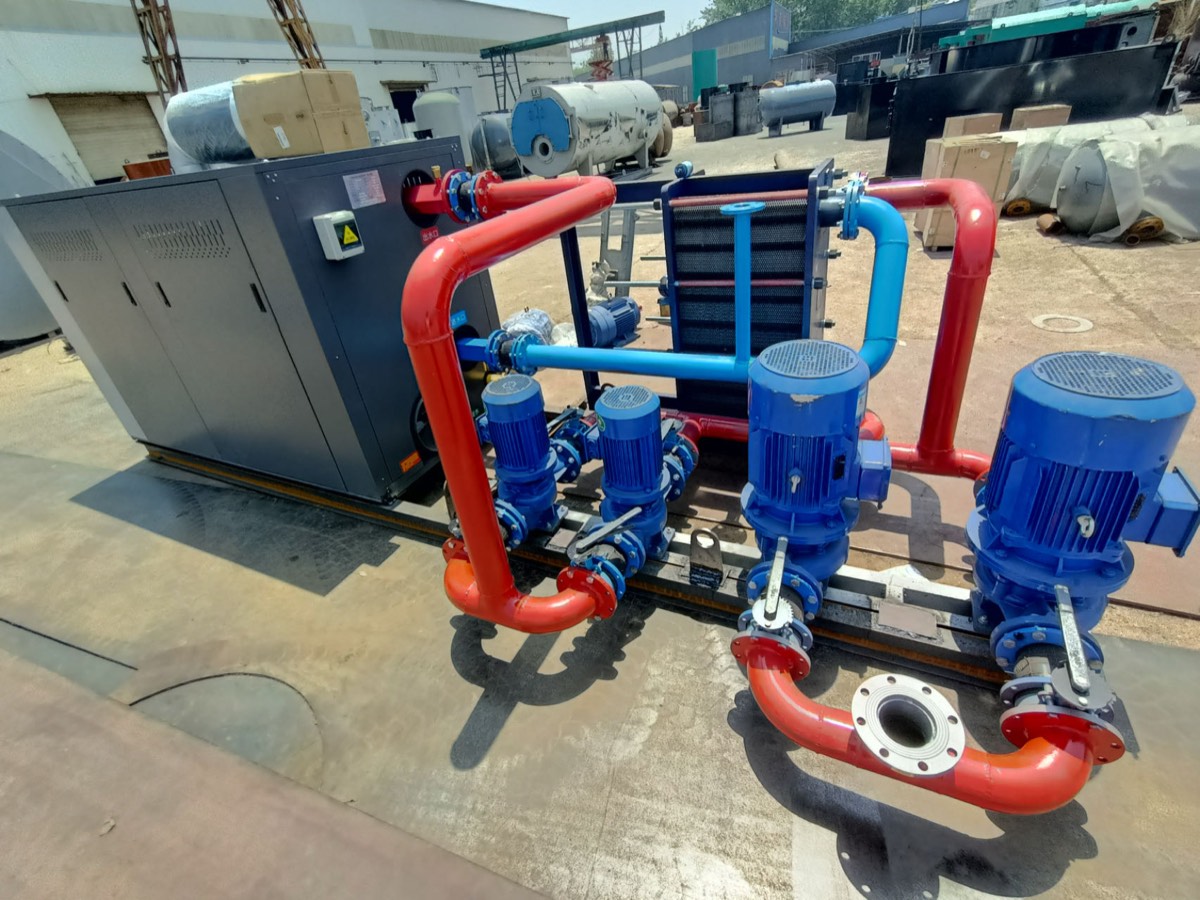
An industrial hot-water boiler can have adequate heating capacity and still leave a factory uncomfortable. Heat must move from the boiler through the piping and emitters, while pressure remains controlled as water heats and cools. Industrial hot-water boiler circulation, expansion provision and hydraulic design therefore belong in the same engineering discussion as boiler selection.
This guide focuses on water-based factory-heating networks. Open and closed arrangements are not interchangeable; the chosen system must suit the boiler’s approved configuration. It does not cover steam distribution or provide installation settings.
Start with heat delivery, not pump horsepower
Establish the heating duty, operating schedule and emitter requirements. A warehouse with intermittent door opening presents a different load pattern from a continuously occupied workshop. Record building heat loss and ventilation assumptions separately from any warm-up allowance. These are project inputs to verify, not fixed allowances to add to every boiler quotation.
For sensible heating of a circulating fluid, heat delivery can be approximated by Q = ṁ × cp × ΔT. Here Q is heat transfer in kW, ṁ is mass flow in kg/s, cp is specific heat in kJ/(kg·K), and ΔT is the water temperature decrease through the load.
As an illustrative calculation, assume 800 kW delivered to the load, water cp = 4.18 kJ/(kg·K), and a selected 20 K temperature difference. Required mass flow is 800 ÷ (4.18 × 20) = 9.57 kg/s. Using an explicitly rounded density of 1,000 kg/m³ gives approximately 34.4 m³/h. These fluid properties and temperature difference are calculation assumptions, not design recommendations.
Actual fluid properties depend on temperature and composition. Glycol mixtures require their own data. Final flow must also satisfy the boiler and emitter manufacturers’ requirements, including permitted operating ranges. See our capacity calculation guide for the thermal-duty context.
Distinguish circulating head from static pressure
In a filled closed circuit, the circulator principally overcomes flow resistance around the circuit. It does not continuously lift the entire water inventory through the building height as an open transfer pump would. Static pressure still matters: elevation changes the pressure available at high points and pump inlets. Caleffi explains this distinction in idronics 16 on hydronic circulation.
Prepare the pump duty from the actual piping network: lengths, internal diameters, fittings, control valves, boiler resistance and heat exchangers. For parallel branches, do not add every branch’s pressure loss in series. The network calculation must establish the controlling route and simultaneous flows. A larger motor alone does not demonstrate that remote heating zones will receive the intended flow.
Check what happens as zones open and close
A single design-duty point does not describe every operating condition. Zone valves change the network resistance, and several pumps can influence one another through shared piping. Hydraulic separation can reduce this interaction by providing a suitably low-resistance common connection between circuits. Caleffi discusses the principle, including closely spaced connections and dedicated separators, in its hydraulic-separation guidance.
Separation is not a guarantee of correct temperatures. Different source-side and load-side flows can cause mixing, so the designer must check both hydraulics and heat balance. Request a schematic that identifies intended flow through each operating boiler, distribution zone and bypass path at minimum and maximum demand.
Size expansion provision for the complete water inventory
Heating water changes its volume. In a closed system, an expansion arrangement accommodates that change; it does not replace pressure-relief protection. Tank selection requires the full fluid inventory, temperature range, fluid type, pressure range and appropriate vessel acceptance characteristics.
The expansion connection also influences the pressure distribution when pumps operate. A tank selected by volume alone does not resolve a poorly located connection. Caleffi explains expansion, the connection’s pressure-reference role and the need for separate protection of isolated closed circuits in its hydronic design fundamentals. Do not transfer residential pressure examples to an industrial installation.
Where a heat exchanger separates two circuits, document which expansion and protective equipment serves each side. Include any later-added piping, buffer vessel or heating zone in the inventory review. Changes that appear small on a floor plan can materially change water volume.
Make measurement part of commissioning
Specify accessible, appropriate measurement points before installation is complete. Compare measured flow and temperatures with the design assumptions under representative zone combinations. Caleffi’s circuit-performance assessment guidance describes the relationship between hydraulic operating point, fluid properties and measured thermal performance.
Unexpected pressure behaviour, persistent air or insufficient heat delivery requires diagnosis, not an automatic increase in pump speed or boiler temperature. Check instruments and records first. Inspection, pressure work and control changes belong with qualified personnel following the approved design and equipment instructions.
Practical assessment checklist
- Identify whether the system is open or closed and confirm boiler compatibility.
- Document heating load, emitters, operating schedule and design temperature assumptions.
- Calculate flow using the actual fluid properties.
- Review pump duty, critical routes and part-load zone combinations.
- Verify the total water inventory and expansion arrangement.
- Identify every hydraulically isolated circuit and its protective provisions.
- Agree commissioning measurements and acceptance criteria before handover.
Frequently asked questions
Is a bigger circulation pump always better?
No. Select it for the required operating range and network resistance, while respecting component flow limits.
Can the expansion tank be selected from boiler capacity alone?
No. System water inventory, fluid expansion and pressure conditions are essential inputs; equal-capacity boilers may serve very different networks.
Does hydraulic separation remove the need for balancing?
No. It reduces interaction between circuits, but each distribution branch still needs appropriate flow and control.
For planning support, share the building duty, piping layout and proposed operating conditions. Also compare steam, hot water and thermal oil before selecting the heat-transfer medium.
Technical references
Primary sources consulted for this guide. Source publication dates and equipment contexts differ; historical examples are not JINHONG performance claims.