
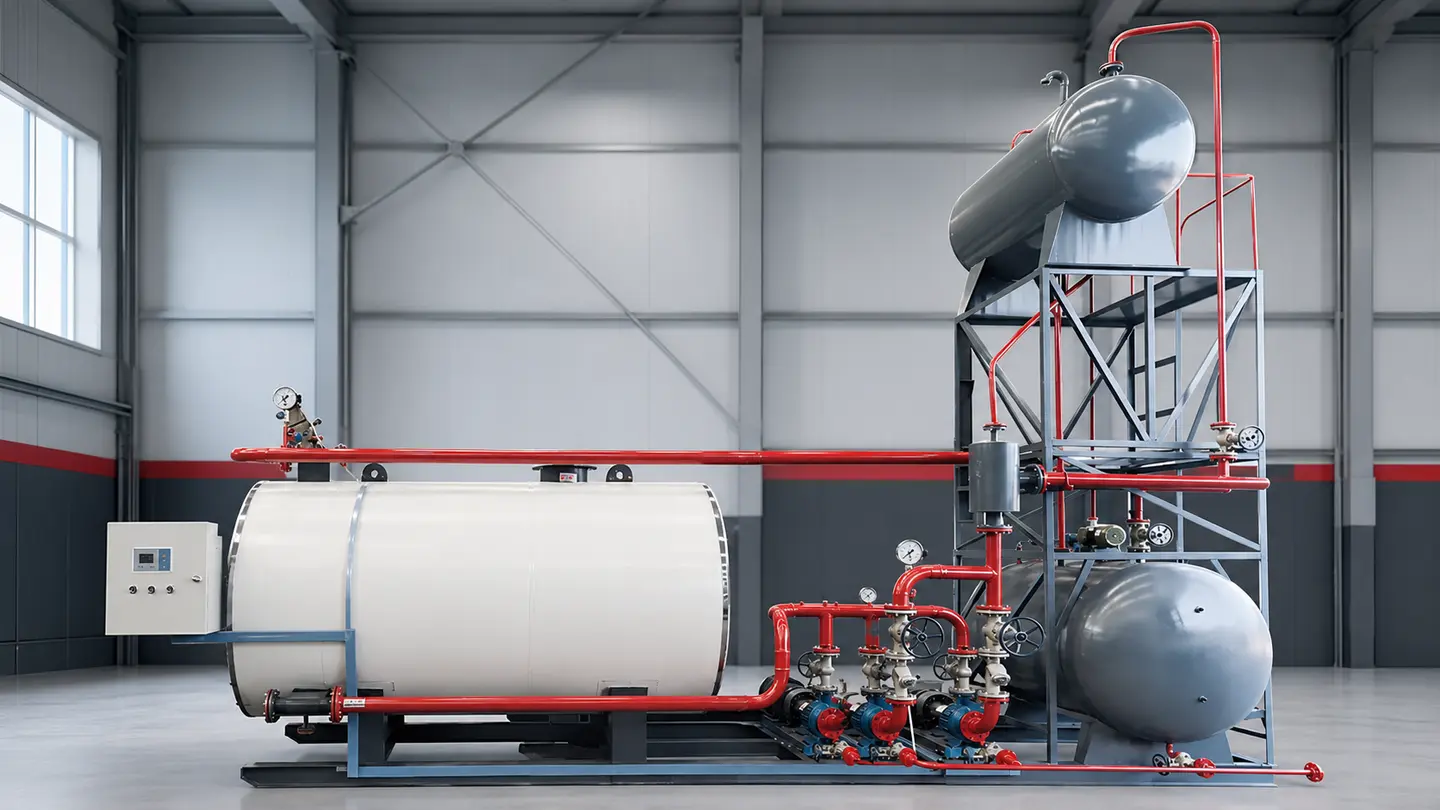
Start with the process, not the boiler name
Steam, hot water and thermal oil deliver heat in different ways. Selecting among them should begin with the temperature required at the process, the acceptable control range, the number and distance of users, and whether the plant can manage water treatment, condensate or heat-transfer fluid.
The same fuel can often be used with different heater types. Fuel availability alone does not decide the heat medium.
How the three media compare
| Factor | Steam | Hot water | Thermal oil |
|---|---|---|---|
| Heat delivery | Latent heat released during condensation | Sensible heat from water temperature change | Sensible heat from circulating fluid |
| Typical strength | Fast transfer, distribution to multiple users, direct or indirect process use | Stable closed-loop heating for moderate temperatures | Higher process temperatures without steam-level system pressure |
| System needs | Water treatment, traps, drainage and condensate management | Pumps, expansion control and water-quality management | Fluid selection, expansion tank, circulation and leak/fire management |
| Control focus | Pressure, steam quality and condensate removal | Flow and supply/return temperature | Film temperature, flow, fluid condition and return temperature |
When steam is a strong candidate
Steam is widely used where rapid heat transfer, sterilization, humidification or direct process injection is needed. It can distribute substantial energy through relatively compact piping, and the condensing temperature is linked to pressure.
The system must drain condensate effectively. Wet steam, failed traps, poor insulation or water hammer can undermine performance even when the boiler itself is correctly selected.
When hot water fits better
Hot water is often appropriate for closed-loop space heating, washing, low-to-moderate temperature process heating and applications where a steady water temperature is preferred. It avoids a steam-condensate network but still requires pumps, expansion management, corrosion control and freeze protection where relevant.
When thermal oil is worth evaluating
Thermal oil can provide high process temperatures while the circulating loop remains at comparatively lower pressure than an equivalent saturated-steam system. It is common in reactors, dryers and heat-transfer equipment that need controlled high temperature.
It is not maintenance-free. Fluid degradation, oxidation, low flow, excessive film temperature and leakage must be managed. The heater, pump, expansion tank, piping and user must be designed as one circuit.
A six-question selection test
- What temperature must the process surface or fluid reach?
- Is direct steam contact required or prohibited?
- How quickly must the process respond to load change?
- How far and to how many users must heat be distributed?
- Can the plant manage water treatment and condensate, or thermal-fluid maintenance?
- What pressure, safety and inspection rules apply locally?
Information to prepare before engineering review
- Process inlet and outlet temperature
- Required heat duty and load variation
- Direct or indirect product contact
- Number and distance of heat users
- Existing steam, water or thermal-fluid infrastructure
- Local pressure-equipment and fire-safety requirements
- Operator skills and maintenance resources
These inputs allow a boiler supplier to check the heat source, pressure, fuel system, auxiliaries and site boundary as one system instead of quoting the boiler body in isolation.
Technical references
This guide summarizes established engineering principles. Final selection must be confirmed against project data, local codes and the equipment manufacturer’s design.