
Steam Water Hammer: Causes, Warning Signs and Prevention Priorities
Distinguish condensate-impact and condensation-induced water hammer, then examine distribution, heat exchangers and return piping as one system.
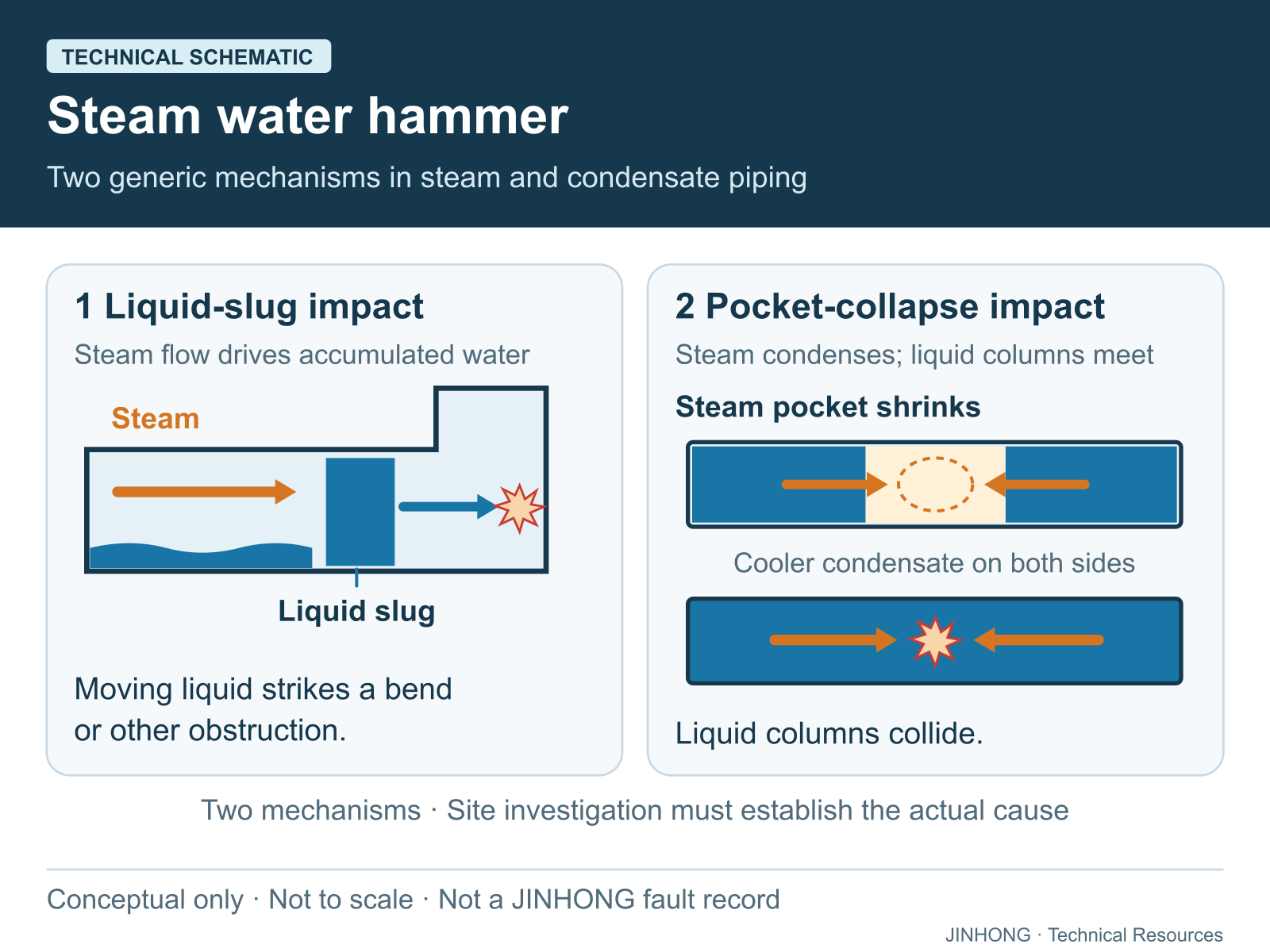
Open full-size technical schematic ↗
Diagram technical references
Steam water hammer is not a normal noise to accept as part of boiler operation. Banging, sharp impacts or abnormal pipe movement can indicate a dangerous steam-and-condensate problem. The apparent noise location may be where an impact is transmitted, not where the conditions first developed. A useful investigation therefore examines the operating event and the connected piping, rather than immediately replacing the nearest valve.
Two mechanisms explain many incidents
In one mechanism, flowing steam accelerates accumulated condensate. The liquid can form slugs that strike bends, fittings or valves. In another, steam contacts cooler condensate and condenses rapidly. The shrinking steam pocket allows surrounding liquid to accelerate and collide. Both mechanisms can produce damaging forces; identifying which conditions are present matters more than debating whether the event should be called water hammer or steam hammer. TLV illustrates the distinction in Water Hammer: The Mechanism.
Do not assume a modest operating pressure makes an impact harmless. A normal boiler pressure reading is not evidence that a local transient was safe. Likewise, the absence of a leak immediately after a bang does not establish that the pressure boundary remains undamaged.
Distribution piping: find where condensate can remain
Steam mains need effective drainage, but fitting traps does not ensure that condensate reaches them. Incorrect slopes, unintended rises and undrained dead-end branches can create collection points. A layout that appears suitable on a schematic may differ from the installed elevations. TLV’s distribution-line guidance stresses the importance of drainage and actual pipe slope.
For the engineering review, compare the current installation with the approved drawings. Include later extensions, relocated equipment and changes around supports. Ask where water could remain after shutdown and whether each intended drainage point serves that location. Do not use an arbitrary new slope or trap-spacing rule without checking the applicable design requirements.
Heat exchangers: review low load as well as full load
A temperature-control valve can reduce steam pressure inside heating equipment as heat demand falls. If the available pressure can no longer overcome the condensate return pressure, discharge can stall and water can accumulate. Supplying steam to a waterlogged region creates conditions for condensation-induced impacts. TLV describes this relationship in water hammer in equipment.
The relevant review includes minimum-load pressure, return backpressure, elevation and the equipment’s drainage arrangement. A larger steam trap does not create the missing driving pressure. Investigate whether a properly engineered assisted-drainage arrangement is necessary. Our steam trap selection and inspection guide explains the information needed to assess the station.
Condensate return lines have their own risks
Return piping may contain both liquid condensate and flash steam. Where hotter flashing flows meet cooler liquid, rapid condensation can produce repeated impacts or more severe hammer. The behaviour depends on how the streams combine and move through the line. TLV discusses these patterns in water hammer in condensate transport piping.
Do not treat the return header as an ordinary cold-water pipe. Record branch temperatures, pressures, intermittent pump discharges and significant changes in elevation. Proposed changes need an assessment of the connected system, including the impact on upstream drainage. For related design questions, see steam condensate recovery design.
Build an event record without recreating the fault
The following investigation checklist is a suggested way to organise information already available from logs, drawings and safe observations:
- When: Did the event coincide with a start-up, shutdown, batch change or another logged production event?
- Where: Which equipment and piping areas were involved, and which locations were only reported by sound?
- Conditions: What pressures, temperatures and load indicators were recorded before and after the event?
- Changes: Had piping, controls, traps or operating schedules recently changed?
- History: Is this a first event or a recurring issue previously treated as routine?
- Evidence: Which observations are confirmed, and which remain an operator’s interpretation?
Preserve the distinction between an observed symptom and a proposed cause. For example, “impact heard when the batch changed” is a useful observation; “the control valve caused it” remains a hypothesis until checked. Do not deliberately repeat a suspected dangerous operating sequence to obtain a recording.
Make prevention part of the operating system
The UK Health and Safety Executive identifies operator training, pipe slope and drainage, condensate collection points, trap operation and isolation valves as important areas for preventing condensate-induced water hammer. Its notice also makes clear that these events are not confined to changing steam flow. The UK-specific legal context should not be mistaken for a universal regulation, but the engineering warning is relevant to industrial steam users. See the HSE condensate-induced water hammer safety notice.
If abnormal impacts, movement or leakage occur, keep people clear and follow the site’s emergency arrangements. Authorised personnel must determine safe shutdown, isolation and inspection requirements. Never loosen connections, open drains or bypass protective equipment as an improvised diagnosis. Restart requires an approved assessment and procedure, not simply waiting until the noise stops.
Frequently asked questions
Can water hammer occur after start-up?
Yes. Load changes, stalled drainage and return-line interactions can create harmful conditions during operation as well as initial warming.
Will slower valve operation solve every case?
No. It does not remove every condition that causes rapid steam condensation. Follow the approved operating procedure and correct the underlying drainage or system-design problem.
Is changing a broken component sufficient?
Not by itself. The investigation must explain the failure conditions and verify the corrective action before the affected system returns to service.
For planned improvements, provide an event record and piping drawing with your service enquiry. This overview does not replace a site-specific risk assessment or qualified pressure-system investigation.
Technical references
Primary sources consulted for this guide. Source publication dates and equipment contexts differ; historical examples are not JINHONG performance claims.