
Steam Trap Selection and Inspection: A Practical Guide for Industrial Plants
Match steam traps to their actual duty and turn inspection results into a traceable repair-and-verification programme.
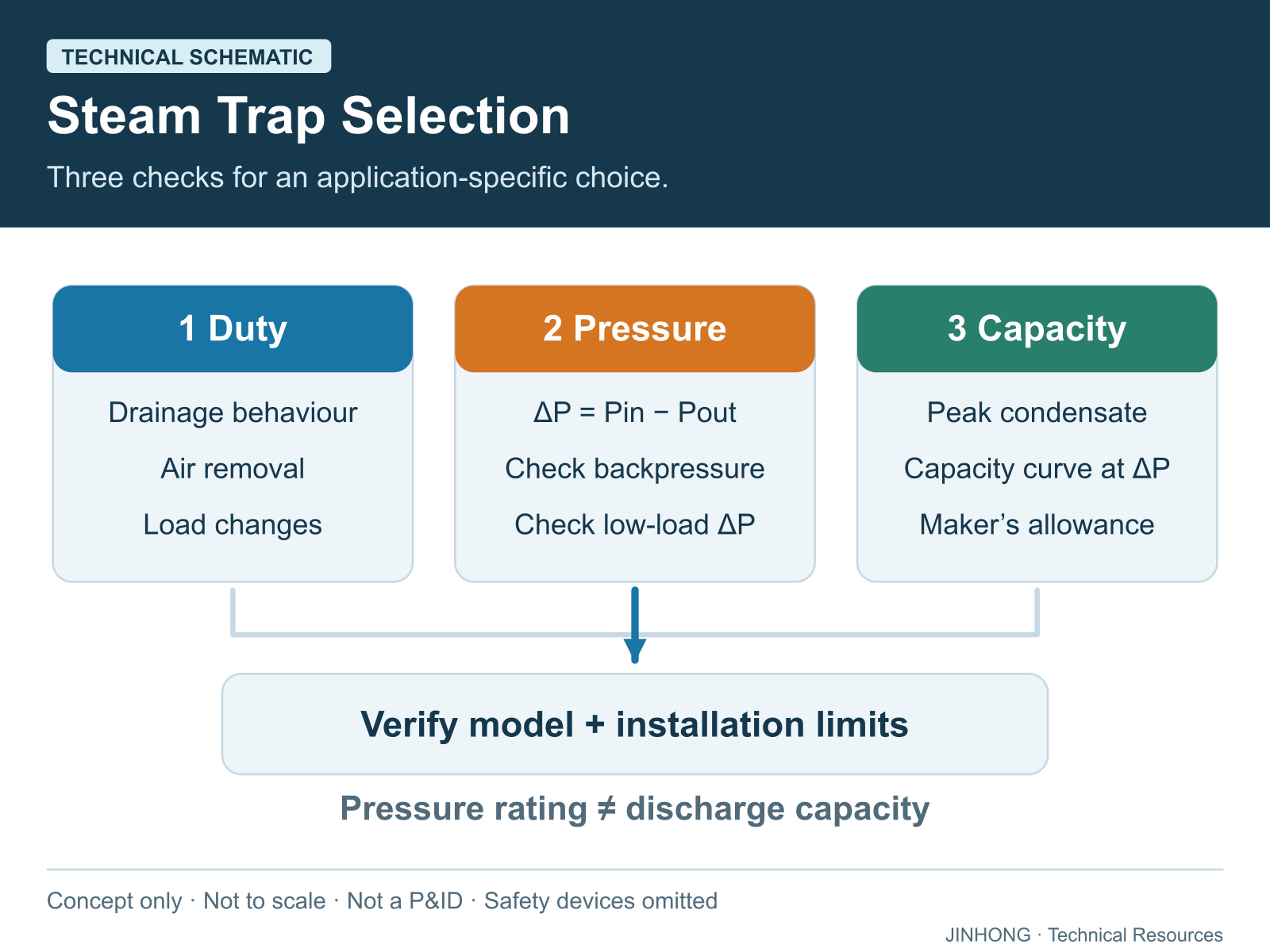
Open full-size technical schematic ↗
Steam trap selection is not a pipe-size matching exercise. A trap may fit the connection and still fail to drain the equipment under its actual operating conditions. Likewise, a trap that feels hot is not necessarily healthy. Reliable selection and inspection start with the duty, then connect the equipment data, test evidence and maintenance outcome.
Define what the trap must do
A steam main, a process heater and a tracing circuit can have different drainage requirements. Main drainage needs to prevent condensate accumulation. Heating equipment may need continuous drainage and effective removal of start-up air. Some tracing applications intentionally use condensate subcooling; that behaviour should not be copied automatically to a duty requiring rapid drainage. TLV describes these application differences in its steam trap selection guide.
Before choosing a model, answer three questions: must the condensate leave near steam temperature; how variable is the load; and can the steam-side pressure fall below the return-system pressure? If the last answer is yes, the design may need assisted condensate removal rather than a larger conventional trap.
Separate pressure rating from discharge capacity
The pressure-temperature rating establishes the permitted service envelope. The capacity curve establishes how much condensate the trap can discharge at a particular differential pressure. These are not interchangeable checks. Specify the operating pressure range, return pressure, start-up load, installation orientation, materials and connection requirements. For context, review boiler pressure versus equipment working pressure.
Start-up and batch loads can exceed the normal condensate load. Apply the selected manufacturer’s application-specific sizing allowance rather than a universal multiplier. TLV’s capacity allowance and life-cycle cost guidance explains why trap behaviour and peak demand influence this allowance. A larger connection alone does not establish adequate capacity at the lowest available differential pressure.
Make the survey repeatable
Assign a permanent location identifier to each drainage station, not merely to the replaceable trap body. A suggested survey record includes:
- Area, equipment tag and a photograph that makes the location unambiguous.
- Trap manufacturer, model, operating mechanism and relevant ratings.
- Whether the process was operating, starting, idle or shut down during the test.
- Test method, instrument identification, pressure information and observed behaviour.
- Condition classification, confidence level and evidence supporting it.
- Proposed action, responsible person and post-repair verification result.
Use an explicit “not tested” category for inaccessible or inactive locations. Do not count those stations as healthy when calculating a fleet failure rate.
Combine evidence instead of relying on one temperature
Visual checks can reveal external leaks or installation problems, but a closed return pipe hides the discharge. Temperature measurements can help identify inadequate drainage when the equipment is known to be in service. However, hot condensate and steam may coexist, so temperature alone cannot reliably establish live-steam leakage. Sound or ultrasound adds useful evidence when interpreted against the trap type, load and pressure. TLV explains the strengths and limitations of these methods in A Guide to Steam Trap Testing.
A quiet, cool trap on idle equipment is a different finding from the same condition on a heater that should be producing. Equally, continuous flow is not automatically a fault: expected discharge patterns depend on the trap mechanism. The survey should state the operating context before assigning a diagnosis.
Investigate the station, not only the valve body
A blocked trap can allow condensate to accumulate, affecting heating and potentially contributing to water hammer. A leaking trap wastes steam. But repeating the same replacement without examining the station can leave the original problem unresolved. TLV’s steam trap management guidance recommends reviewing the whole drainage location, including associated piping and valves, and analysing recurring failures.
For example, if one location repeatedly receives a new trap, ask the engineer to compare its design conditions with current production. Has a return line changed? Was the process converted from steady to batch operation? Does the model still match the installed orientation? These questions turn a replacement history into a useful investigation rather than proof that every trap of that type is unreliable.
Close the maintenance loop safely
Prioritise findings by safety, process consequence and verified energy loss, not simply by which repair is easiest. Set inspection frequency from site risk, operating history and manufacturer guidance; there is no single interval appropriate to every plant. Repair methods and replacement parts must follow the relevant manufacturer’s instructions. Spirax Sarco discusses diagnosis and repair considerations in testing and maintenance of steam traps.
Only authorised, trained personnel should inspect or work on pressurised steam equipment. Opening a trap requires the approved isolation, depressurisation and safe-work procedure. Do not bypass the trap as a routine cure. Recheck the repaired station under a meaningful operating condition and retain that result with the original finding.
Frequently asked questions
Can one trap model serve every application?
Not automatically. Standardising spare parts is useful only where the same model satisfies each location’s actual duty and service conditions.
Does a cold trap always need replacement?
No. Confirm that the process is active and investigate drainage conditions. The observation identifies a question, not necessarily a failed component.
What makes a survey commercially useful?
Traceable findings, prioritised corrective work and verified closure. A spreadsheet of trap temperatures without operating context is not enough.
Include drainage-station information when discussing boiler-system service requirements, or return to the technical resource library for related engineering topics.
Technical references
Primary sources consulted for this guide. Source publication dates and equipment contexts differ; historical examples are not JINHONG performance claims.