
Steam Boiler vs Steam Generator: How to Choose for Industrial Process Steam
A process-led comparison of industrial steam boilers and compact steam generators, focused on load, pressure, steam quality, utilities, operating pattern and complete project responsibility.
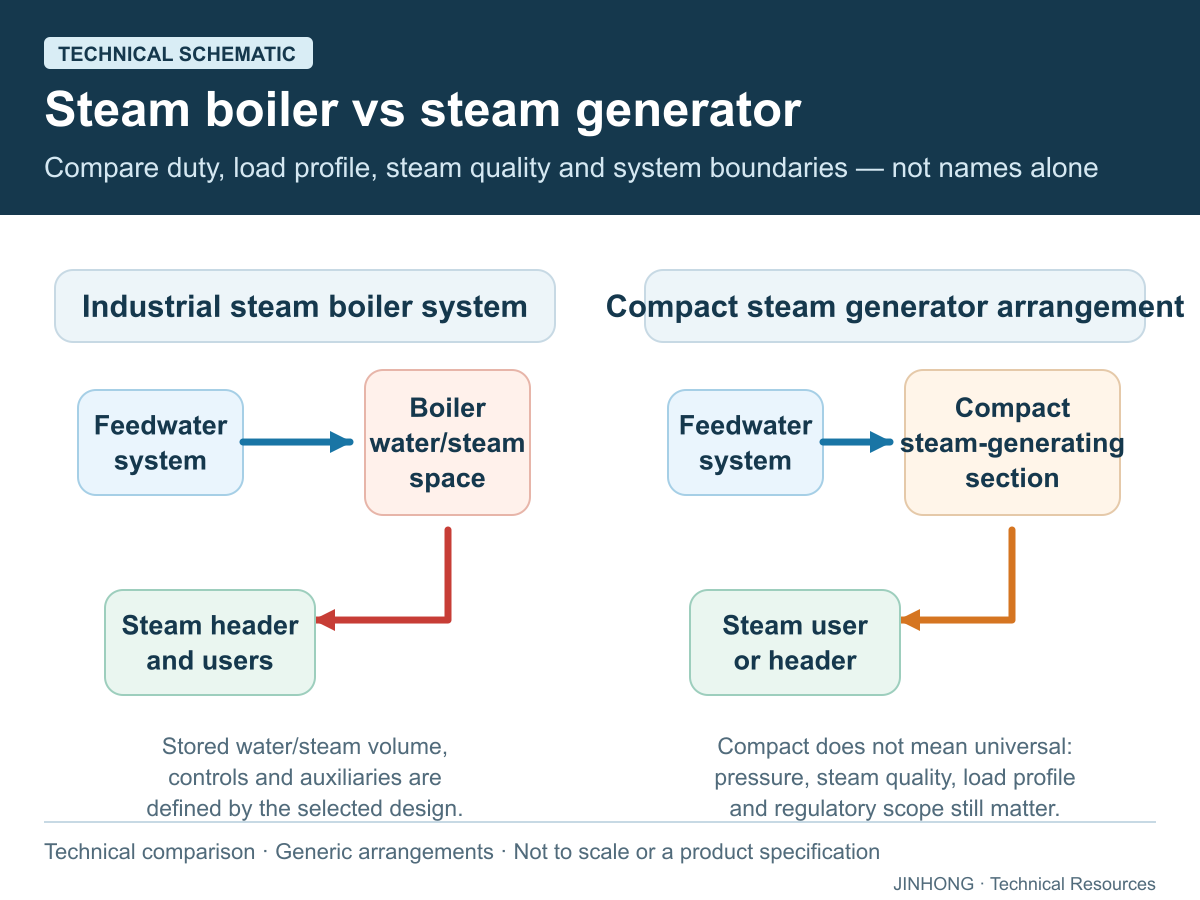
The right choice is the steam-producing system that can meet the process load, pressure and steam-quality requirement through the real operating schedule. A compact steam generator is not automatically the better option for a small load, and a conventional steam boiler is not automatically the safer choice for a large factory. Commercial names also vary, so the equipment construction, approved operating limits and destination-country classification must be checked rather than inferred from the label.
For JINHONG projects, the comparison begins with process data and ends with a defined equipment and site-work boundary. Buyers should compare complete systems under the same assumptions, not one boiler body against another supplier’s fully equipped package.
Start with the process duty, not the equipment name
Record the maximum and normal steam demand, warm-up load, operating hours, pressure required at each user and the amount of condensate expected to return. Identify whether machines operate continuously, in batches or simultaneously. The existing industrial boiler capacity guide explains why connected machine ratings alone do not establish the required boiler output.
Next define the steam condition. Saturated steam is suitable for many heating duties, but the permissible moisture, pressure variation and response time depend on the process. A laundry dryer, dyeing machine, reactor and sterilizing process do not create the same duty merely because each consumes steam. Review boiler pressure versus equipment working pressure before selecting a nameplate pressure.
Compare water inventory and heat-transfer arrangement
A shell or fire-tube steam boiler stores a larger mass of hot water and steam within its pressure vessel. Spirax Sarco describes shell boilers as equipment whose combustion gases pass through tubes surrounded by boiler water. That stored thermal mass can help buffer some load changes, but it also affects warm-up, standby losses, installation weight and water-treatment responsibility.
Some compact steam generators use a low-water-content or forced-flow coil arrangement. Clayton’s official description is one manufacturer-specific example: a pump moves water through a helical coil and a separator delivers steam. Other generators use different constructions. Do not transfer one manufacturer’s claimed response, efficiency or safety characteristics to a JINHONG product or to every device sold as a steam generator.
| Selection question | Conventional steam boiler route | Compact generator route |
|---|---|---|
| Load pattern | Often evaluated for sustained plant demand and stored-water response | Often evaluated for distributed, intermittent or faster-response duty |
| Steam condition | Depends on vessel, separation, water level and load | Depends on flow control, separator and operating range |
| Utilities | Fuel, treated feedwater, power, blowdown and flue route | The same interfaces still require verification; compact does not mean utility-free |
| Project classification | Defined by applicable pressure-equipment rules | Must also be checked under applicable local rules, regardless of the sales name |
Match the operating range and control philosophy
Ask for the permitted operating range, minimum stable output, startup sequence and response to sudden demand changes. A headline maximum capacity does not show whether the unit will cycle excessively during normal production. If several machines start together, determine whether the steam source, header and distribution piping can recover without unacceptable pressure loss.
Water level or feedwater-flow control must suit the construction. The burner or electric heating stages, feed pump, separator, alarms and shutdown logic form one control system. These functions must be commissioned for the approved unit; operators should never compensate for poor load matching by bypassing alarms or changing protected settings. The turndown and short-cycling guide provides a separate review of part-load behavior.
Compare the complete installed system
Footprint should include access for burner removal, tube or coil inspection, pump maintenance, electrical panels, feedwater equipment and safe operation. A compact body may still need a feedtank, water treatment, fuel train, chimney, blowdown arrangement and steam header. Confirm transport openings, foundation loads and the route from the steam source to each user.
Use the complete boiler-system boundary to compare scope. JINHONG’s WNS steam boiler, compact LSS boiler and gas/oil steam generator represent different equipment routes; final suitability depends on verified project data, not the position of a product in this comparison.
Define compliance, testing and ownership before purchase
ASME PTC 4 provides performance-test procedures for fired steam generators, but it does not turn an informal site check into a code test. If efficiency or output acceptance matters, agree the fuel basis, feedwater condition, steam condition, instruments, test boundary and uncertainty in writing. Separately, identify the pressure-equipment, fuel-gas, electrical, emissions and operator requirements that apply at the destination.
The responsible parties should be named for design review, local permits, installation, pressure testing, burner commissioning, water treatment, training and ongoing examination. HSE guidance emphasizes documented operating limits, competent people and management of changes. Its legal setting is the United Kingdom; local law and the approved equipment documentation remain controlling elsewhere.
Frequently asked questions
Is a steam generator always faster to start?
Not every design behaves the same way. Water inventory, heating method, cold-start condition, controls and the required steam condition all affect startup. Request data for the exact proposed model and duty.
Is a steam generator exempt from boiler regulations?
Do not assume that from the product name. Classification depends on the equipment construction, pressure, volume and destination-country rules. Confirm it with the responsible local authority or qualified specialist.
Which option is better for fluctuating demand?
Either route may be workable when correctly selected. Compare the normal load, peaks, minimum stable output, storage effect, sequencing and the response required at the process.
What should be included in a quotation comparison?
Compare output and pressure under stated conditions, burner or heating package, feedwater equipment, controls, water treatment, emissions equipment, documentation, installation responsibility, commissioning and acceptance testing.
Send JINHONG the process load, pressure, fuel, utilities and operating schedule for an engineer-reviewed equipment route. No model or performance commitment should be made before those conditions are confirmed.
Technical references
Primary and official sources consulted for this guide. Source publication dates, jurisdictions and equipment contexts differ; examples are not JINHONG performance claims.