
Boiler Economizer Selection: Match Heat Recovery to the Whole Plant
A practical selection framework for non-condensing and condensing economizers, including heat demand, water chemistry, fouling and retrofit integration.
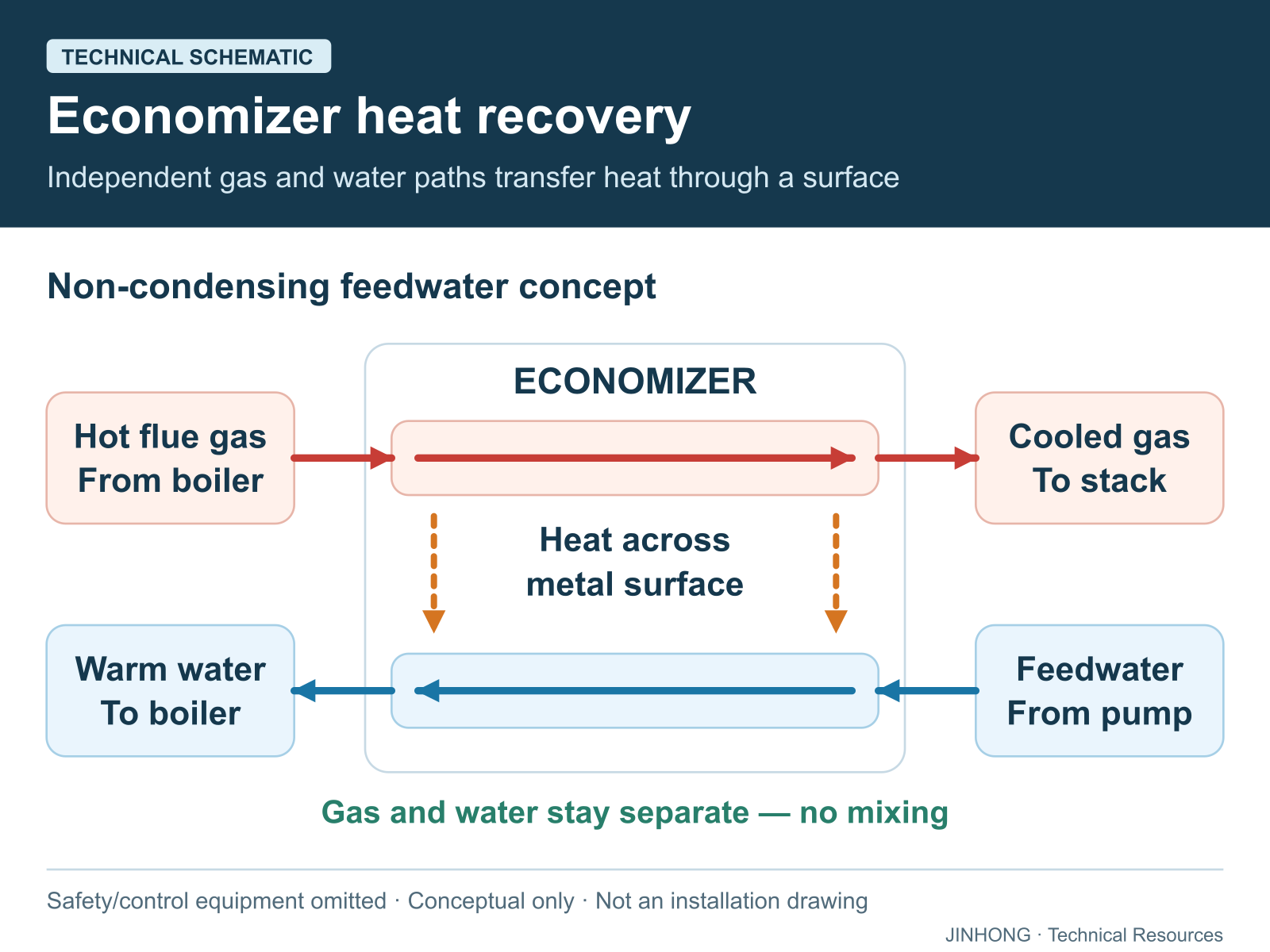
Open full-size technical schematic ↗
Diagram technical references
A boiler economizer recovers heat that would otherwise leave with the flue gas. The attractive part of the proposal is the recovered thermal output. The harder engineering question is whether the factory can use that heat, at the available temperature, whenever the boiler produces it.
Boiler economizer selection should therefore begin with a heat balance and operating profile. Selecting the largest exchanger that fits the chimney connection is not a substitute for evaluating the boiler, water system and final heat user together.
Understand the two recovery approaches
A conventional, non-condensing feedwater economizer transfers flue-gas heat to incoming boiler feedwater while the intended gas-side operation remains above relevant condensation limits. The DOE describes feedwater economizers as a means of reducing fuel demand by recovering available exhaust heat. Its screening guidance is not a universal design temperature for every fuel or chimney. DOE feedwater-economizer guidance.
A condensing economizer is deliberately designed to recover additional heat by condensing water vapor from combustion. This requires a suitable low-temperature heat user, compatible equipment and a plan for the resulting liquid. DOE guidance specifically calls for site engineering and assessment of the existing steam and water systems. DOE introduction to condensing economizers.
| Selection question | Non-condensing recovery | Condensing recovery |
|---|---|---|
| Where can the heat go? | Often boiler feedwater | Often cold makeup water or another low-temperature water demand |
| What must the design manage? | Unwanted condensation and fuel-dependent deposits | Intentional condensation, corrosion and condensate handling |
| What makes the output useful? | Compatible feedwater flow and temperatures | A sufficiently cool, available heat sink during boiler operation |
| What must be checked annually? | Real load hours and usable heat | Real load hours, heat demand and treatment costs |
Match the heat source to an actual demand
Prepare simultaneous operating profiles, not unrelated annual totals. The boiler may run continuously while a cleaning process requires hot water only briefly. Unless a properly designed storage arrangement bridges that difference, much of the theoretical heat cannot displace purchased energy.
Record the receiving water flow, inlet temperature, required outlet temperature and hours of demand. Check how these change in summer, during reduced production and when condensate return improves. A heat user already supplied by recovered energy cannot be credited as if it were entirely heated by new fuel.
An illustrative heat-sink limit
Assume a process has 2,000 kg/h of water available for a 25°C temperature rise. Using an approximate water heat capacity of 4.18 kJ/kg·K, its heat demand is 2,000 × 4.18 × 25 ÷ 3,600 = about 58 kW. A proposed recovery unit capable of 100 kW cannot continuously deliver 100 kW of useful savings to that demand alone.
This example uses assumed values and ignores exchanger approach temperatures, variable properties and losses. Its purpose is to expose a demand mismatch before detailed design. Storage or an additional heat user would need its own engineering and cost assessment.
Condensate and materials are part of the equipment scope
Condensed flue-gas water is not automatically clean boiler makeup water. Its composition depends on the fuel and combustion products. Direct-contact recovery and indirect heat exchange also create different separation requirements. The design must address corrosion resistance, treatment, drainage and permitted discharge or reuse. DOE’s selection guidance discusses acidic condensate, water treatment and potential impacts on other heat-recovery equipment. DOE condensing-economizer selection considerations.
Bulk exhaust temperature is not the only check. Ask the designer to assess cold-end tube-metal and entering-water temperatures against fuel-specific condensation risks. Bosch describes inlet-water temperature control as protection against condensation and corrosion in its feedwater-cooler guidance.
Do not describe a generic stainless-steel unit as suitable for every fuel. Provide fuel composition and expected contaminants to the designer. For solid fuels, include ash characteristics and anticipated deposits; for dual-fuel equipment, evaluate both fuels rather than the most favorable operating mode.
Check retrofit integration before approving the purchase
Chimney requirements, cleaning access and the fuel’s tendency to foul heat-transfer surfaces can change the arrangement. Bosch’s planning guidance describes controlled and standalone economizer configurations, including arrangements relevant to minimum exhaust temperatures and sulfur-containing secondary fuels. These are examples of design choices, not interchangeable instructions for an existing boiler. Bosch economizer planning guidance.
- Confirm available fan pressure margin and the effects of added gas-side resistance.
- Review water-side pressure rating, hydraulic resistance and compatible feedwater controls.
- Allocate physical space for inspection, cleaning, tube work and safe maintenance access.
- Have the designer assess startup, low-load and loss-of-water-flow conditions.
- Define instrumentation, acceptance testing and the operating manual in the supply scope.
These checks should be completed by the responsible equipment and site engineers. An economizer must not be added by changing pressure parts, bypassing safeguards or experimenting with lower exhaust temperatures.
Judge the investment by useful annual recovery
Compare recovered heat actually used over the year against installation, fan and pump energy, water treatment, cleaning and maintenance costs. Keep assumptions visible. A short advertised payback from another site is not evidence for this factory. Review efficiency measurement boundaries and the complete boiler-system components when comparing proposals.
Frequently asked questions
Is a condensing economizer always the better choice?
No. Its additional recovery may not justify the complexity if the site lacks a suitable low-temperature heat demand or compatible installation conditions.
Can an existing boiler receive an economizer?
Often a retrofit can be evaluated, but suitability depends on the actual boiler, fuel, draft system, water circuit and available space.
Does lower exhaust temperature guarantee fuel savings?
No. The recovered heat must serve a real demand, while the complete installation remains within its approved operating and material limits.
Ask JINHONG to review your heat-recovery requirements with boiler records, fuel data and a receiving-water demand profile.
Technical references
Primary sources consulted for this guide. Source publication dates and equipment contexts differ; historical examples are not JINHONG performance claims.
- DOE Steam Tip Sheet 3: Use Feedwater Economizers for Waste Heat Recovery
- DOE Steam Tip Sheet 26A: Consider Installing a Condensing Economizer
- DOE Steam Tip Sheet 26B: Considerations When Selecting a Condensing Economizer
- Bosch Steam Boiler Planning: Economiser
- Bosch Steam Boiler Planning: Feed Water Cooler