
Biomass Boiler Slagging and Fouling: Diagnose Ash Before Changing Fuel
Ash quantity does not explain every deposit problem. Connect fuel chemistry, deposit location and operating evidence before selecting a corrective measure.
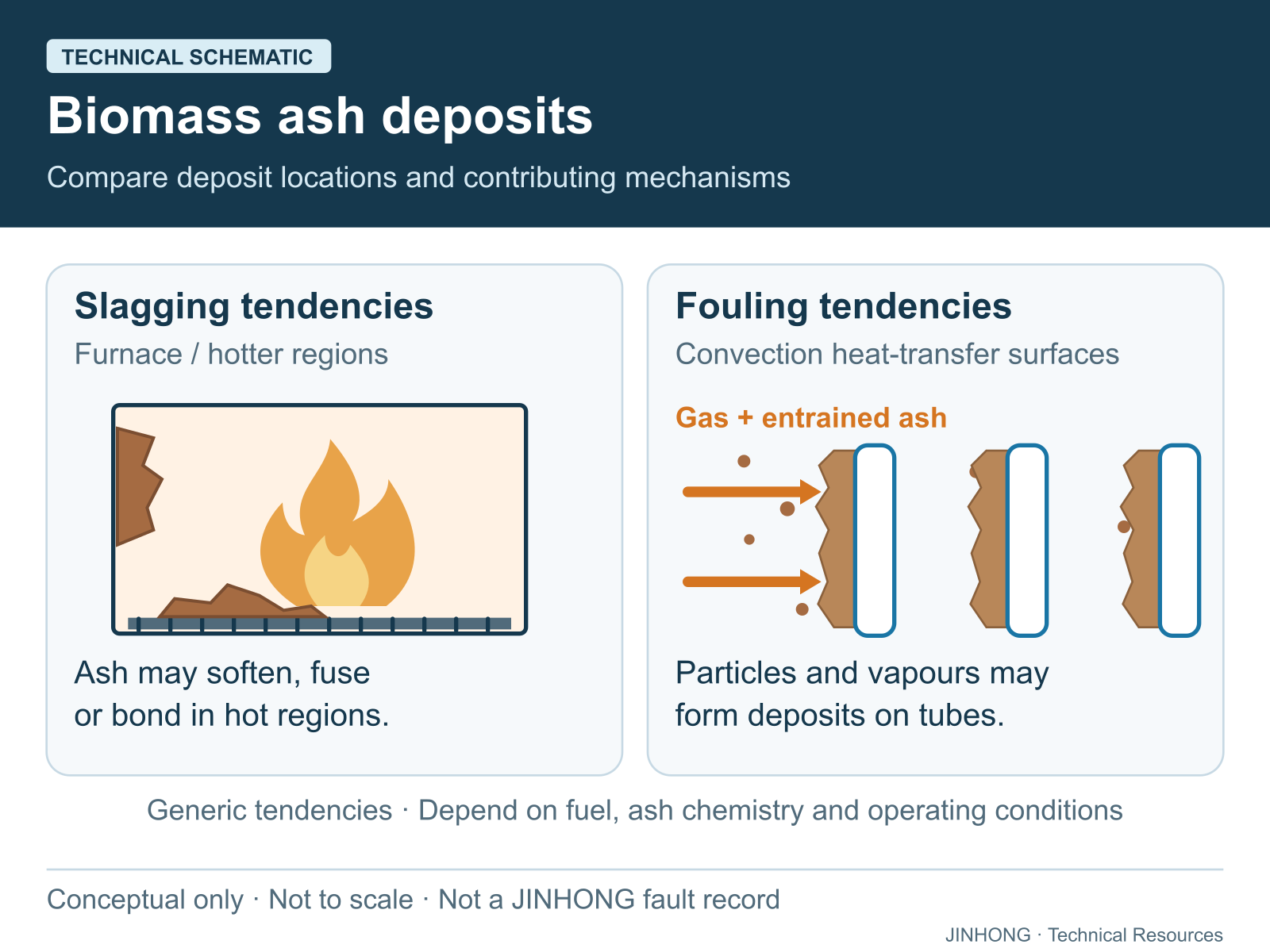
Open full-size technical schematic ↗
Start with the deposit, not a promised fuel upgrade
Biomass boiler slagging is often described as a bad-fuel problem. Fuel matters, but a useful investigation asks a more precise question: which material accumulated, where did it accumulate, and under what operating conditions? A replacement fuel with lower ash content can still behave poorly in a furnace that was not designed for its chemistry or physical form.
This guide extends the biomass fuel evaluation checklist from purchasing specifications to deposit diagnosis. It does not assign a universal safe ash percentage, furnace temperature or cleaning interval. Those limits belong to the approved boiler design and its operating procedures.
Slagging, fouling and corrosion are different findings
| Finding | Typical observation | Question for the investigation |
|---|---|---|
| Slagging or bed agglomeration | Fused or strongly bonded ash around hot combustion surfaces or the fuel bed | How did local temperature, ash chemistry and fuel distribution interact? |
| Convective fouling | Deposits on downstream heat-transfer surfaces | What transported material to the surface and made it adhere? |
| Corrosion or erosion | Metal loss or localized damage, sometimes beneath deposits | Which damage mechanism is supported by inspection evidence? |
The IEA Bioenergy Task 32 technical report explains why ash behavior depends on both inorganic composition and combustion conditions. It also warns against applying conventional coal slagging indices directly to pure biomass. A deposit photograph is therefore a starting point, not a complete diagnosis. Source: IEA Bioenergy — biomass ash characteristics.
Why total ash content is not enough
Two laboratory reports can show similar ash percentages while the resulting deposits differ substantially. Alkali compounds, silica, chlorine and sulfur can participate in different reactions and transport mechanisms. The distribution of those elements matters as well as their total amount.
The NREL-sponsored Alkali Deposits Investigation combined laboratory work with full-scale boiler observations. Its findings connect deposit behavior with fuel properties, plant design and operating conditions, rather than one fuel number. This is a reason to request representative fuel and deposit analyses together; it is not a basis for copying an old research threshold into a new boiler guarantee. Source: NREL — Alkali Deposits Found in Biomass Power Plants.
Build an evidence pack that can distinguish causes
The following is a practical investigation framework, not an operating instruction. Collect records through approved sampling points and inspection arrangements; do not open hot equipment to obtain a better photograph.
- Identify the fuel batch. Record supplier, delivery date, declared feedstock, storage history and any blending change.
- Describe the sample basis. Label moisture and ash results as received or dry basis. Ask the laboratory to state methods and sampling limitations.
- Map the deposit. Give each sample a location, date and photograph. Separate grate material from tube-bank deposits and collected fly ash.
- Align the time records. Compare fuel changes with load, flue-gas temperature, draft or pressure-drop trends and cleaning events.
- Record competing explanations. Instrument error, air leakage, changed throughput or a different cleaning condition can distort an apparent fuel comparison.
- Preserve maintenance evidence. Document blocked passages, refractory condition and any measured tube damage for the responsible engineer.
Pair each fuel record with the deposit evidence
Turn the evidence pack into linked records. Use a sample identifier consistently across the photograph, laboratory report and operating log. Record any uncertainty about whether the sampled fuel actually represents the period when the deposit formed. Obtain samples only through the site’s approved, safely isolated inspection arrangements.
| Linked record | Fields to capture | Why the link matters |
|---|---|---|
| Fuel batch and sample | Batch ID, delivery and use dates, sampling method, moisture basis and laboratory report ID | A convenient fresh sample may not represent the fuel that formed an older deposit. |
| Deposit sample | Sample ID, mapped location, collection date, photograph and laboratory report ID | Grate material, tube-bank deposits and collected fly ash answer different questions. |
| Operating window | Fuel or blend, load range, relevant temperature and pressure-drop trends, cleaning events | Changes in duty or cleaning can confound a fuel comparison. |
| Review and follow-up | Observations, competing explanations, missing evidence and responsible reviewer | A visual description is not yet a verified mechanism or an approved remedy. |
Hypothetical comparison: dark grate residue, a hard fused lump and a downstream tube deposit should not all receive the same label from photographs alone. The first may prompt a check for unburned material; the second for ash bonding and local combustion conditions; the third for deposit composition and transport. Appearance alone cannot establish any of these explanations. Refer combustion-specific questions to the chain-grate combustion troubleshooting guide.
Before evaluating an approved change, agree comparable fuel and load windows, how deposit growth or cleaning demand will be documented, and what inspection evidence is required. Log differences that prevent a fair comparison instead of presenting a cleaner photograph as proof of success. Keep purchasing acceptance criteria in the separate biomass fuel evaluation checklist.
Keep storage contamination separate from inherent fuel chemistry
Not every ash problem begins inside the furnace. Soil, stones, bark proportions and handling contamination can change the delivered material. Forest Research highlights the need to match woodfuel supply to the equipment’s permitted fuel specification, including particle form and contaminants. Receiving controls should therefore cover more than the supplier’s nominal heating value. Source: Forest Research — woodfuel supply.
For procurement, keep an agreed reference sample and a documented acceptance process. An unexplained batch change should trigger review, not an assumption that all materials called wood chips, pellets or agricultural residue are interchangeable.
Choose corrective options with their trade-offs visible
A useful review separates immediate safe plant management from a permanent engineering change. Fuel substitution, screening, blending, furnace modifications and revised cleaning systems answer different problems. Each proposal needs an owner, evidence requirement and acceptance criterion.
- Fuel specification: compare the candidate fuel against the approved design envelope and actual deposit analysis.
- Cleaning arrangement: review access, deposits and tube condition before selecting a method or intensity; excessive cleaning can create another damage mechanism.
- Combustion review: have qualified personnel assess distribution and operating trends. Do not alter protections to keep a deteriorating boiler online.
- Pretreatment or additives: ask what changes in ash behavior, emissions, wastewater, maintenance and total cost, not only whether a laboratory test improved.
IEA research on leaching herbaceous biomass demonstrates why removing problematic constituents also creates a supply-chain question: water use, contaminated wastewater and subsequent drying must be assessed. Experimental removal rates are not promised results for another fuel or site. Source: IEA Bioenergy — herbaceous biomass leaching study.
Define success before approving a change
A useful acceptance plan compares agreed operating windows, not an unusually clean first day with an old worst-case photograph. Record load and fuel basis, heat-transfer indicators, deposit development, cleaning demand, relevant emissions and inspection findings. Set project-specific review criteria with the equipment supplier and responsible plant team. The outcome may be better fuel control, a different design or a revised maintenance strategy; no single remedy is universal.
Use the complete boiler system boundary to include ash handling and emission control in the discussion. For a project review, provide the fuel reports, operating history and photographs through the technical proposal form.
Frequently asked questions
Does low-ash biomass guarantee a clean boiler?
No. Ash quantity and ash behavior are different questions. The assessment must also consider composition, combustion conditions, surface arrangement and operating evidence.
Can more air cure biomass boiler slagging?
Not as a universal remedy. An air change affects combustion and heat distribution and needs a qualified review against the approved operating envelope. It should not be used to mask a fuel or equipment mismatch.
Can a different biomass fuel be accepted from one laboratory result?
One result may support screening, but it does not establish consistent supply or long-term performance. Agree representative sampling, the permitted fuel envelope and a controlled engineering evaluation before changing the approved fuel.
Technical references
Primary sources consulted for this guide. Source publication dates and equipment contexts differ; historical examples are not JINHONG performance claims.