
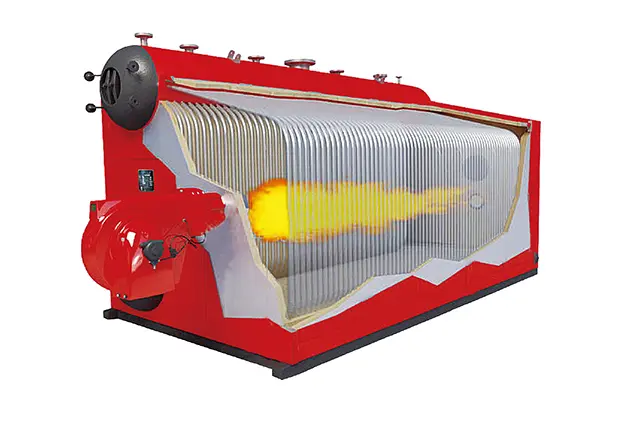
The basic construction difference
In a fire-tube boiler, hot combustion gas passes through tubes surrounded by water in a shell. In a water-tube boiler, water and steam circulate inside tubes heated from the outside by combustion gas.
This change in where the water sits affects pressure capability, stored water volume, response, furnace arrangement, manufacturing and maintenance. It does not by itself determine efficiency or quality; the complete design and controls matter.
Follow the heat path through the tube wall
Read this simplified construction comparison from the hot side to the water side. The separating metal transfers heat; combustion gas and boiler water follow different paths.
| Fire-tube shell arrangement | Water-tube drum arrangement |
|---|---|
| Gas inside: combustion gas travels through the furnace and smoke tubes. | Water inside: water and a steam-water mixture circulate through heated tubes connected to drums. |
| Heat path: hot gas → tube wall → water surrounding the tubes. | Heat path: furnace or flue gas outside → tube wall → water inside. |
This comparison follows Spirax Sarco’s shell-boiler and water-tube explanations. Pass count, drum layout and circulation details still need the selected manufacturer’s drawing.
A practical comparison
| Selection factor | Fire-tube | Water-tube |
|---|---|---|
| Common strength | Compact packaged arrangement and straightforward access for many small-to-medium duties | Scalable heating surface and furnace arrangement for higher capacity, pressure or demanding fuels |
| Water volume | Generally larger stored water volume | Generally lower water inventory in tubes and drums |
| Load response | Stored energy can buffer short changes; large shells respond more gradually | Can respond quickly when circulation and controls are correctly designed |
| Fuel/furnace flexibility | Well suited to packaged gas/oil firing and some solid-fuel designs | Provides more freedom for large furnaces, grate systems and high heat release duties |
| Water quality | Still requires a pressure-specific treatment program | Small tubes and high heat flux can make water-quality discipline especially important |
| Maintenance focus | Tube cleaning, tube sheets, furnace and shell-side water condition | Tubes, headers/drums, circulation, refractory and gas-side deposits |
When a fire-tube package is attractive
A packaged fire-tube boiler can be a strong fit for stable gas or oil service, moderate capacity and pressure, limited boiler-house complexity, and customers who value factory assembly. Burner turndown, furnace geometry, pressure drop, access and verified performance still require review.
Fire-tube does not mean “small only.” Different passes, furnace arrangements and package sizes cover a broad range, but each manufacturer’s verified limits should guide selection.
When a water-tube design deserves priority
Water-tube construction is often evaluated for higher capacities or pressures, rapid load response, larger solid-fuel furnaces, multiple burners, superheat, or projects where modular transport is important. The plant must support suitable water chemistry, instrumentation and operator training.
For biomass, the combustion system may drive the decision. Adequate furnace volume, residence time, air staging and ash control can be more important than a simple tube-layout label.
Use project constraints to decide
- Confirm capacity, pressure, steam quality and load range.
- Evaluate fuel characteristics and required furnace size.
- Check transport dimensions, site erection and boiler-room space.
- Review raw water, treatment capability and operator skill.
- Compare service access, spare parts and planned maintenance.
- Ask for guaranteed performance at the specified fuel and conditions.
Same rated capacity, different project configuration
Two documented JINHONG projects both specify 6 TPH and 1.25 MPa, yet use different product families. These are confirmed equipment ratings, not hypothetical loads or measured site output.
- Egypt textile dyeing project: WNS6-1.25-Q, a natural-gas fire-tube package, supplied for an added production line. Installation, line connection, commissioning and training were completed.
- Uzbekistan solid-fuel project: SZL6-1.25-T, a water-tube configuration for coal or compatible biomass, with specified dust collection, wet flue-gas treatment, induced draft, ducting and chimney.
The purchasing lesson is that capacity and pressure alone do not settle the construction. Compare the available fuel, furnace and emissions equipment, installation scope, maintenance access and operating resources before requesting matched proposals. A buyer considering gas or oil can also evaluate the SZS water-tube family already linked below when its verified design suits the duty.
These cases document different equipment and supply boundaries. They do not establish a universal capacity cutoff, prove one construction more efficient, or demonstrate a measured fuel-saving or pressure-stability advantage.
Information to prepare before engineering review
- Normal and peak steam demand
- Operating and design pressure requirements
- Fuel analysis and emission limits
- Minimum load and required response
- Transport route and installation space
- Raw-water analysis and treatment capability
- Inspection, cleaning and tube-repair access
These inputs allow a boiler supplier to check the heat source, pressure, fuel system, auxiliaries and site boundary as one system instead of quoting the boiler body in isolation.
Technical references
This guide summarizes established engineering principles. Final selection must be confirmed against project data, local codes and the equipment manufacturer’s design.