
HORIZONTAL BIOMASS ATMOSPHERIC HOT WATER BOILER
CDZL / CDZH Biomass Hot Water Boiler
One horizontal biomass hot-water boiler family with two firing routes: automatic chain-grate feeding for CDZL duties and hand-fired fixed-grate operation for the smaller CDZH range.
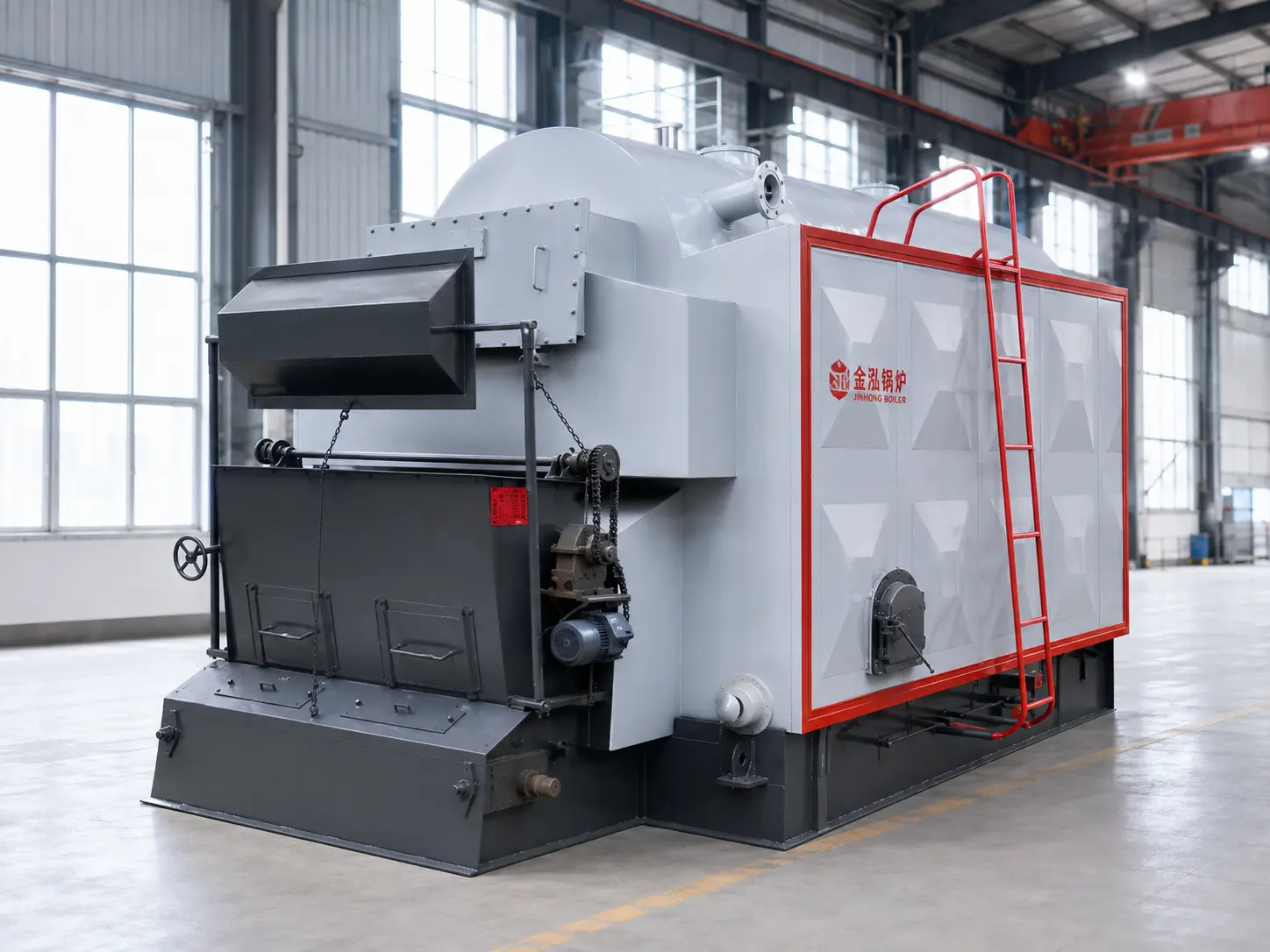
- CDZL Range
- 0.7–7 MW
- CDZH Range
- 0.7–2.8 MW
- Water Temperatures
- 85 / 60°C
- Working Route
- Atmospheric
PRODUCT OVERVIEW
One Boiler Family, Two Practical Biomass Firing Routes.
CDZL and CDZH share the same basic purpose: converting biomass heat into an atmospheric hot-water circuit. They are grouped here because customers first select the required heat output and water conditions, then choose the firing route that fits the fuel, operating hours and labor plan.
CDZL uses an automatic feeding and moving chain-grate route across the 0.7–7 MW CDZL / CDZH product range. CDZH uses manual charging and a fixed grate for the 0.7–2.8 MW range. Final configuration follows the approved fuel data, proposal and drawings.
Atmospheric Boiler Route
The boiler-side circuit is kept open to atmosphere through an approved expansion and venting arrangement.
Two Firing Options
Select automatic chain-grate feeding or manual fixed-grate charging from fuel form, output, operating hours and labor availability.
Direct or Separated Load
A compatible load may use the boiler circuit directly, while a plate heat exchanger can hydraulically separate another circuit.
Engineered Plant Boundary
Pumps, water treatment, expansion, heat recovery, controls, chimney and customer interfaces are defined together.
FIRING OPTIONS
Choose the Combustion Route After the Heat Duty Is Defined.
The rated output and 85/60°C water reference describe the thermal duty. Fuel handling, grate movement, labor demand and operating continuity determine whether CDZL or CDZH is the better route.
CDZL · AUTOMATIC CHAIN GRATE
Continuous Fuel Feeding for Longer Operating Duties.
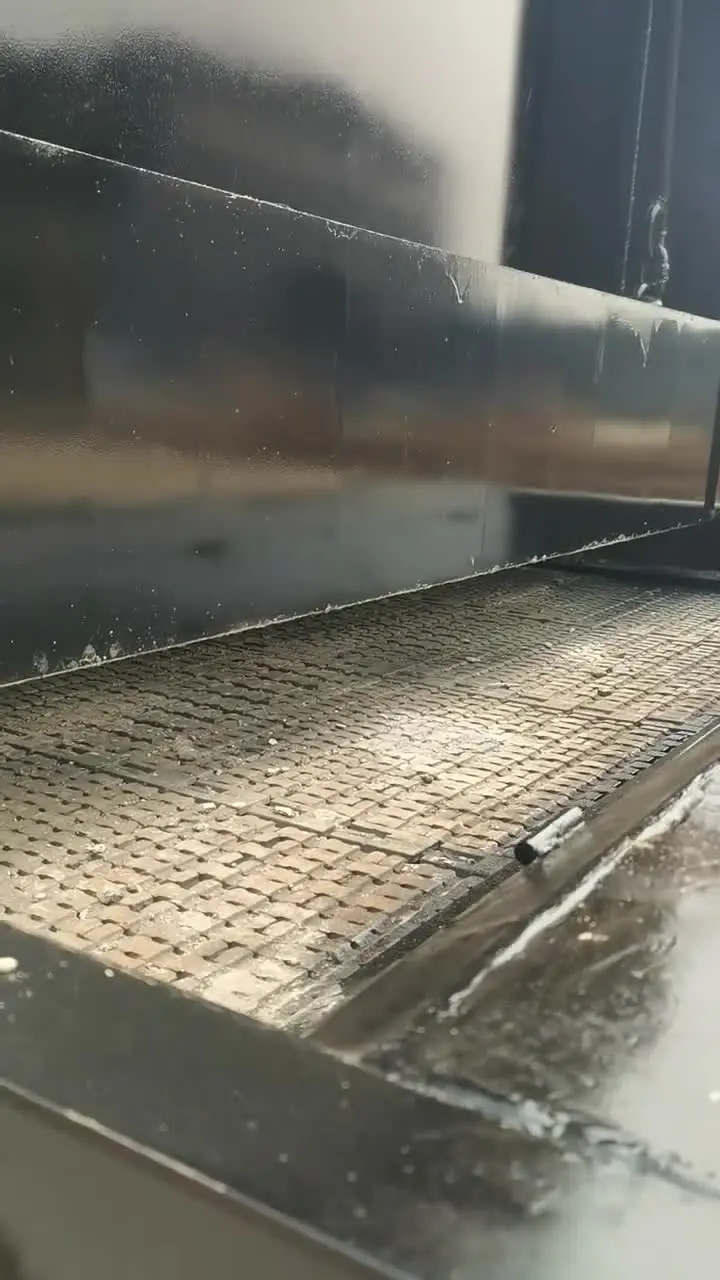
A hopper, feeder and motorized chain grate move prepared biomass through controlled combustion zones. The route reduces routine charging labor and supports steadier operation when fuel size and moisture remain within the agreed range.
CDZH · HAND-FIRED FIXED GRATE
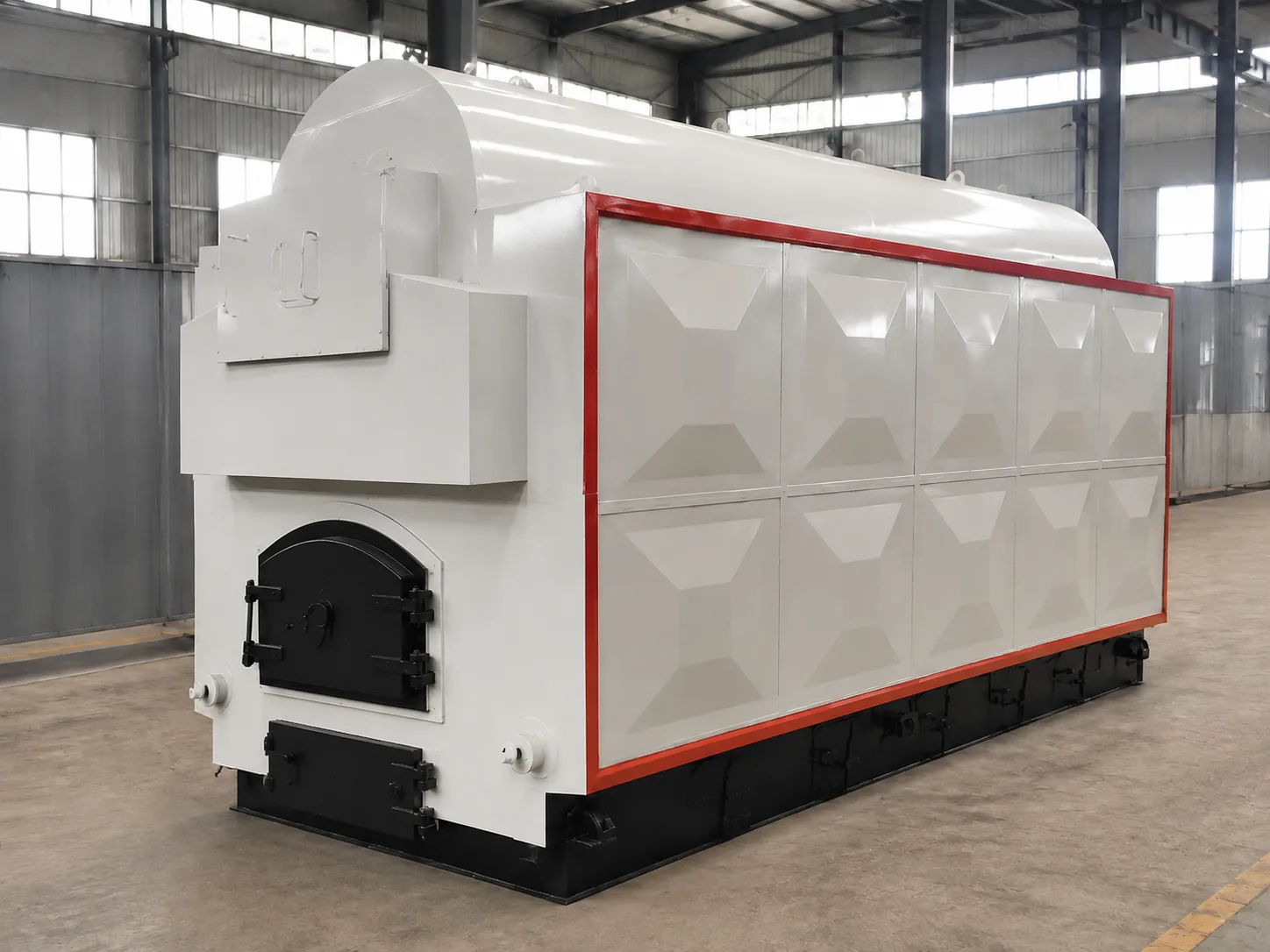
A Simpler Fuel Route for Smaller Heating Duties.
Prepared biomass or firewood is charged manually onto a fixed grate. The simpler arrangement can suit smaller loads and sites with available operating labor, but output stability still depends on disciplined charging, fuel-bed control and combustion-air adjustment.
Neither route is universally better. The selection follows output, fuel form, operating hours, labor availability, automation target, ash behavior and local emissions requirements.
COMBUSTION & WATER CIRCUIT
One Water Circuit with Two Fuel-Charging Routes.
Prepared biomass is either metered onto the CDZL moving chain grate or charged manually onto the CDZH fixed grate. Primary and secondary air support combustion while flue gas passes the designed heating surfaces and then the selected heat-recovery and particulate-control equipment.
The circulation pump moves heated water to the load and returns cooled water to the boiler. Minimum flow, return temperature, water quality, open expansion, low-water and over-temperature protection must be coordinated before firing.
REFERENCE SYSTEM DIAGRAMS
Compare Automatic and Hand-Fired System Routes.
This simplified diagram shows the main equipment and flow direction for discussion. Final pipe sizes, elevations, expansion, valves, instruments, redundancy, heat recovery, local-code provisions and control points follow the approved calculations and drawings.
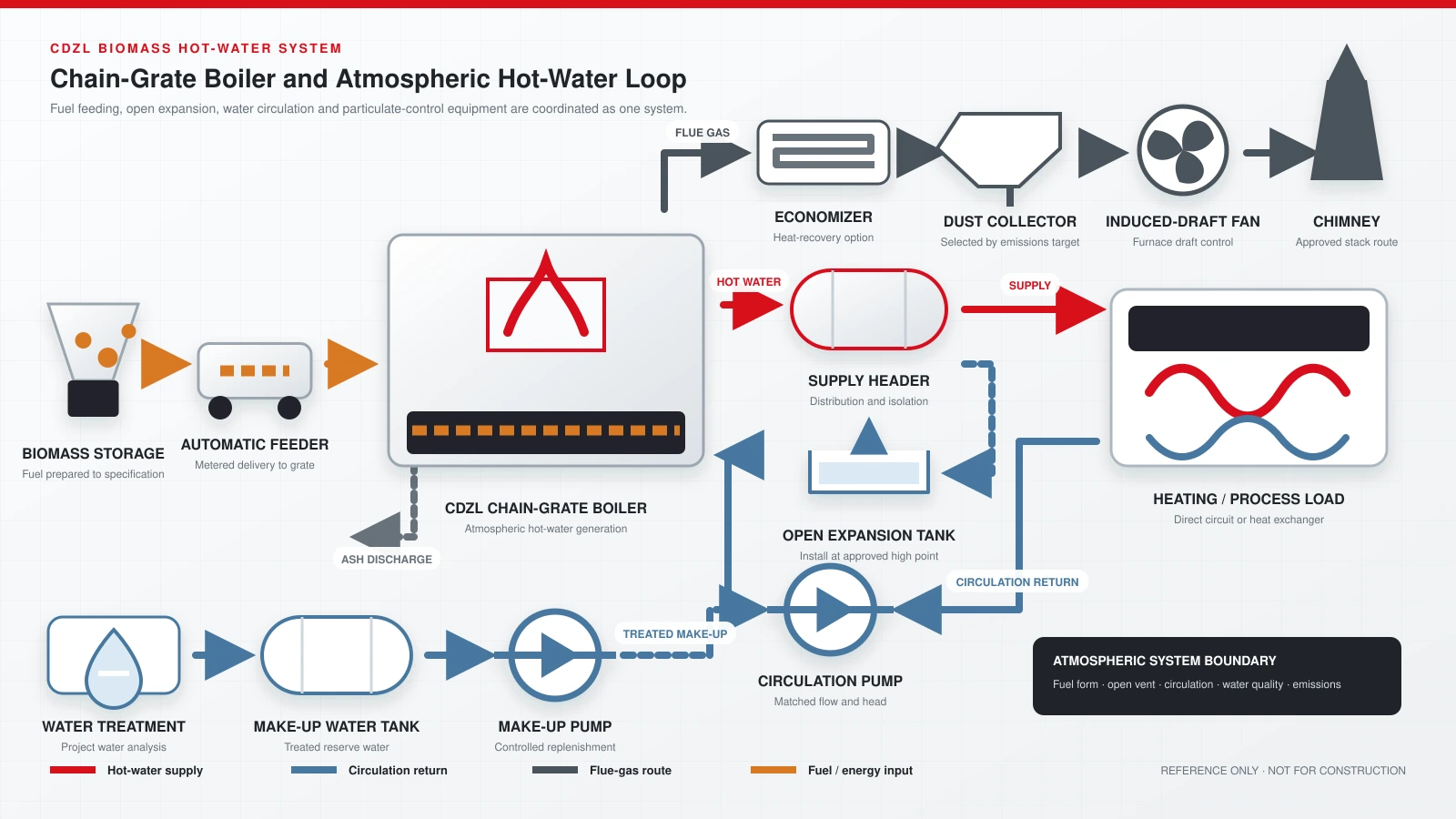
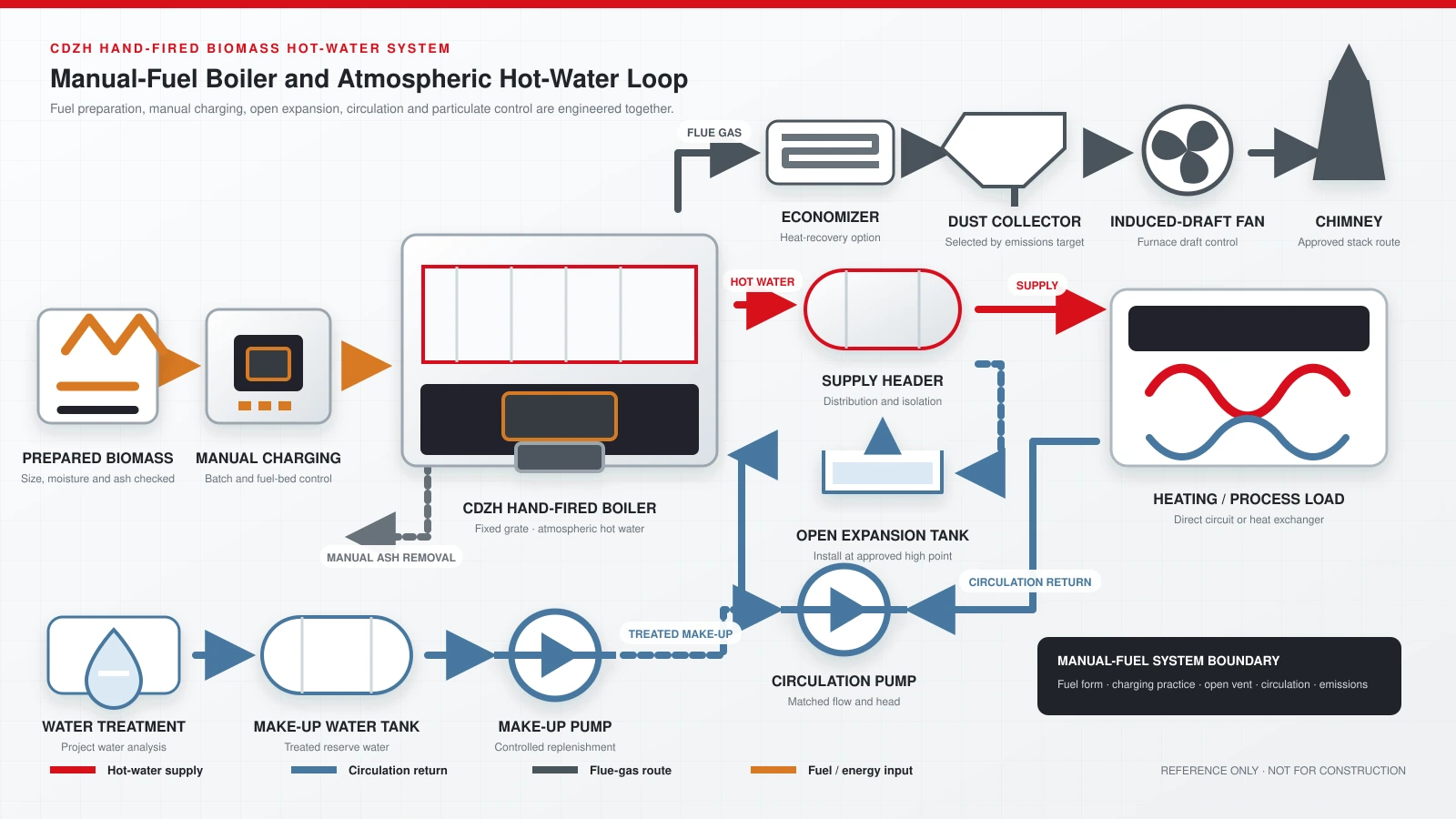
These are discussion references, not construction drawings. Final pipe sizes, elevations, valves, instruments, expansion, protection, redundancy and customer interfaces follow the approved calculations and drawings.
DESIGN FEATURES
Shared Hot-Water Engineering with Route-Specific Fuel Handling.
Horizontal Boiler Body
The horizontal boiler route integrates the furnace and convection heating surfaces with the selected grate arrangement.
Matched Firing Route
Choose the CDZL moving chain grate or CDZH fixed grate from fuel form, combustion rate, ash behavior and required output.
Primary & Secondary Air
Air distribution is coordinated with fuel-bed thickness and furnace conditions for more complete combustion.
Fuel & Ash Access
Feeding, inspection, soot-cleaning and ash-removal points are arranged for practical operation and maintenance.
Water & Temperature Protection
Low-water, over-temperature and circulation conditions are coordinated with grate, fan and shutdown logic.
Atmospheric System Route
The approved open expansion and vent path is treated as part of the protection concept, not as an optional accessory.
TECHNICAL DATA
CDZL and CDZH Models Verified from the JINHONG CDZL / CDZH product range.
The first four output points are available with either the CDZH hand-fired route or the CDZL automatic chain-grate route. The 4.2–7 MW reference points are CDZL only. Final selection follows the actual fuel and project duty.
| Model | CDZH0.7 / CDZL0.7 | CDZH1.4 / CDZL1.4 | CDZH2.1 / CDZL2.1 | CDZH2.8 / CDZL2.8 | CDZL4.2 | CDZL5.6 | CDZL7.0 |
|---|---|---|---|---|---|---|---|
| Rated Heat Output MW | 0.7 | 1.4 | 2.1 | 2.8 | 4.2 | 5.6 | 7.0 |
| Rated Heating Capacity × 104 kcal/h | 60 | 120 | 180 | 240 | 360 | 480 | 600 |
| Working Route | Atmospheric | Atmospheric | Atmospheric | Atmospheric | Atmospheric | Atmospheric | Atmospheric |
| Outlet Water Temperature °C | 85 | 85 | 85 | 85 | 85 | 85 | 85 |
| Return Water Temperature °C | 60 | 60 | 60 | 60 | 60 | 60 | 60 |
| Thermal Efficiency % | ≥86 | ≥86 | ≥86 | ≥86 | ≥86 | ≥86 | ≥86 |
| Reference Heating Area m² | 6,000 | 12,000 | 18,000 | 24,000 | 36,000 | 48,000 | 60,000 |
| Boiler Heating Surface m² | 31 | 69.5 | 100 | 126 | 138 | 173 | 233 |
| Grate Surface Area m² | 1.85 | 2.8 | 3.4 | 4.6 | 7.8 | 10.4 | 12.8 |
| Boiler Water Volume m³ | 2.1 | 3.3 | 4.6 | 5.8 | 6.6 | 8.5 | 10.3 |
| Power Consumption kW | 8.5 | 13.6 | 16.2 | 38.5 | 55.6 | 68 | 94.5 |
| Transport Weight CDZH / CDZL, t | 13 / 15 | 18 / 20 | 21 / 24 | 23 / 26 | — / 35 | — / 46 | — / 58 |
| Reference Overall Size L × W × H, mm | 3680 × 1840 × 2800 | 4460 × 2240 × 3150 | 4980 × 2350 × 3486 | 5274 × 2440 × 3570 | 7320 × 2733 × 3620 | 7735 × 3020 × 3881 | 8400 × 3264 × 4538 |
Fuel basis: The current JINHONG table identifies biomass particles and firewood. Final selection requires the actual fuel form, size, moisture, ash and lower heating value.
Model pairing: CDZH and CDZL share the 0.7–2.8 MW reference output points but use different firing arrangements. The paired transport-weight values are shown as CDZH / CDZL; 4.2–7 MW is CDZL only.
Heating area: technical data reference only. Floor area is not a sizing guarantee; the actual building or process heat balance, climate, envelope, ventilation and operating schedule control selection.
Efficiency: The current model table lists ≥86%. Actual performance depends on delivered fuel, load profile, combustion adjustment, heat recovery, water temperatures, maintenance and the agreed test boundary.
Dimensions and weight: Reference only. Use the approved general-arrangement drawing for transport, lifting, foundation, boiler-room access and maintenance planning.
BIOMASS FUEL ENGINEERING
Match the Firing Route, Furnace and Air System to the Real Biomass.
“Biomass” is not one fixed fuel. A dependable proposal requires representative samples or data for form, particle size, moisture, ash, lower heating value, bulk density, supply method and expected seasonal variation. These conditions also determine whether manual CDZH charging or automatic CDZL feeding is practical.
Send fuel and heating data- 01Fuel Form & Size
Pellets, chips, shells, briquettes and firewood require different storage, feeding and combustion arrangements.
- 02Moisture Content
Moisture changes useful heat input, ignition behavior, furnace temperature, fuel consumption and stable output.
- 03Ash & Slagging
Ash content and fusion behavior affect grate loading, air distribution, cleaning and ash-removal design.
- 04Lower Heating Value
Representative LHV data is required before estimating hourly fuel use and confirming grate area.
- 05Firing & Feeding Route
Manual CDZH charging or automatic CDZL feeding is selected from fuel form, output, autonomy, labor and plant layout.
- 06Emissions Target
Local particulate and other applicable limits determine the dust collector and complete flue-gas route.
BOILER & SYSTEM BOUNDARY
A Complete Biomass Hot-Water Plant Extends Beyond Either Boiler Body.
The boiler must be coordinated with the selected manual or automatic fuel route, combustion air, ash removal, circulation pumps, open expansion and venting, water treatment, particulate control, heat recovery, chimney, electrical control and every customer-side connection.
Plant piping, customer pumps, building terminals, heat exchangers, civil works, installation, local approvals and utilities are included only when explicitly listed in the agreed supply scope.
Define the system boundaryAPPLICATIONS
Biomass-Fired Hot Water for Heating and Compatible Processes.
Application suitability depends on the useful heat load, required temperatures, circuit type, water quality, operating schedule and local requirements—not industry name alone.
Industrial Space Heating
Factory, warehouse and workshop heating through a compatible circulation or separated terminal-water circuit.
Hotels & Commercial Buildings
Central heating and domestic-hot-water preparation through an approved heat-exchanger and hygiene design.
Hospitals & Campuses
Building heating and service-water preparation where separation, redundancy and operating schedules are defined.
Food & Beverage Plants
Cleaning, washing and indirect process heating through a suitable sanitary or process heat exchanger.
Textile & Laundry Facilities
Washing, hot-water preparation and space heating subject to actual temperature and peak-demand profiles.
Greenhouses & Agricultural Heating
Low-temperature distribution circuits sized from climate, growing area, envelope losses and control zones.
COMPLETED PROJECT · KAZAKHSTAN 2026
2.8 MW CDZH Hot Water Boiler for Residential Heating.
JINHONG supplied a hand-fired coal and wood hot-water boiler package for residential heating in Kazakhstan, with on-site installation, commissioning and operator training.
Read the Kazakhstan residential heating project caseSELECTION GUIDANCE
Select the Output First, Then the Firing Route and Complete System.
A dependable proposal separates normal and peak duty, verifies design temperatures and flow, then selects CDZH manual firing or CDZL automatic feeding from the fuel, operating schedule and labor plan before defining the complete atmospheric hot-water system.
Review industry solutions- 01Useful Heat Load
Provide normal and peak kW or kcal/h, operating hours and simultaneous demand instead of floor area alone.
- 02Supply & Return Temperatures
The approved temperature difference determines circulation flow, heat-transfer area and pump selection.
- 03Direct or Separated Circuit
Confirm whether the load can use the atmospheric boiler circuit or requires a plate heat exchanger.
- 04Water Quality & Make-Up
Send raw-water analysis, make-up rate and expected leakage so the treatment route can be defined.
- 05Manual or Automatic Firing
Confirm operating hours, labor availability and automation target so CDZH or CDZL can be selected on a practical basis.
- 06Fuel & Emissions
Provide biomass form, size, moisture, ash, LHV, supply route and the applicable emissions requirements.
- 07Site Conditions
Confirm altitude, ambient temperature, power supply, boiler-room access, chimney route and destination codes.
FREQUENTLY ASKED QUESTIONS
CDZL / CDZH Biomass Hot Water Boiler FAQ.
Are CDZL and CDZH the same boiler family?
They serve the same atmospheric biomass hot-water duty and share the 0.7–2.8 MW reference output points. CDZL uses automatic feeding and a moving chain grate; CDZH uses manual charging and a fixed grate.
How do I choose between CDZL and CDZH?
Choose after reviewing output, fuel form, operating hours, labor availability and automation target. CDZH can suit smaller manually attended duties, while CDZL supports automatic feeding and the wider output range.
What capacity ranges are listed in the JINHONG technical data?
CDZH is listed from 0.7 to 2.8 MW. CDZL is listed from 0.7 to 7 MW, equal to 60–600 × 104 kcal/h across the full CDZL range.
What do the 85/60°C values mean?
They are the listed outlet and return water temperatures. Other project temperatures require engineering review because they change water flow, heat-transfer conditions, pump duty and system performance.
Are these pressurized hot-water boilers?
The CDZL and CDZH series described here are atmospheric. The boiler-side circuit must retain an approved open expansion and vent route. A closed customer circuit can be separated through a heat exchanger where appropriate.
Can either boiler burn any type of biomass?
No single grate and feeding arrangement suits every fuel. Fuel form, size, moisture, ash, lower heating value and seasonal variation must be reviewed before the furnace, grate and air system are confirmed.
Is the technical data heating-area value a sizing guarantee?
No. It is a reference only. Climate, building envelope, ventilation, useful process load, temperatures, operating schedule and system losses determine the required output.
What is normally included in a complete system?
The defined package may include the boiler, selected firing and feeding route, fans, ash removal, circulation pumps, open expansion, water treatment, make-up tank, controls, economizer, dust collector and chimney. Only the approved proposal defines final supply.
What information is needed for a technical proposal?
Send normal and peak heat load, supply and return temperatures, application, operating hours, circuit arrangement, water analysis, biomass data, emissions target, power supply, altitude, destination and required scope.
START WITH LOAD, CIRCUIT & FUEL DATA
Get a CDZL or CDZH Proposal Matched to the Real Operating Plan.
Send the normal and peak heat demand, supply and return temperatures, application, operating hours, labor plan, circuit arrangement, water analysis, biomass data, emissions target and destination. JINHONG will select the firing route and define the complete system boundary for technical review.