
SINGLE-DRUM BIOMASS STEAM BOILER
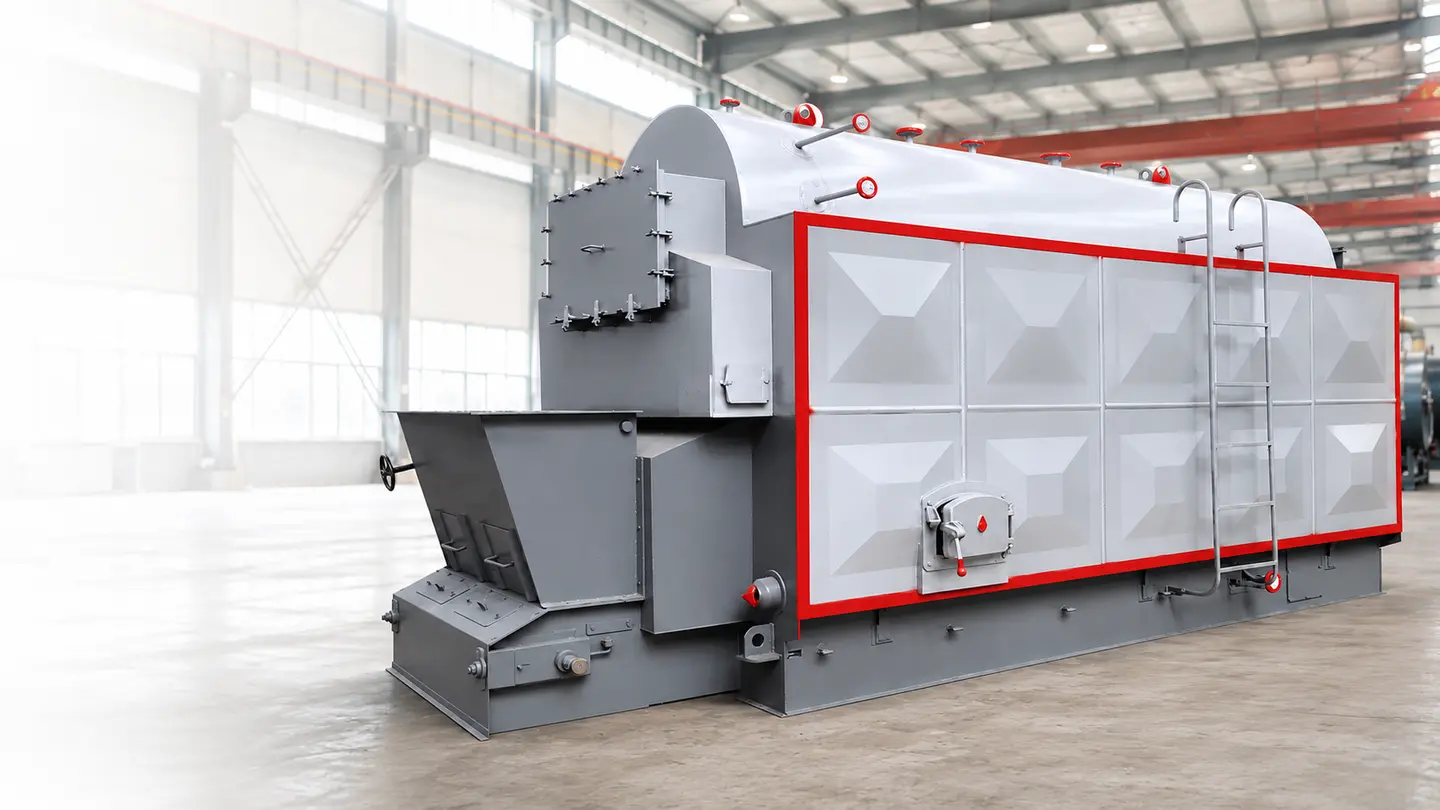
DZL Biomass Chain Grate Steam Boiler
Biomass chain-grate steam boilers from 1-10 t/h for factory process steam. Share your available biomass and estimated steam demand to start a fuel review and quotation.
Start with the fuel name and what you know; a laboratory report is not needed for the first enquiry. Rice husk and bagasse are not assumed suitable for a standard configuration.
Tiếng Việt: tư vấn nồi hơi sinh khối DZLVietnamese enquiry guide · full technical information remains on this page.
- Steam Capacity
- 1–10 t/h
- Pressure Routes
- 1.0–1.6 MPa
- Firing System
- Chain Grate
- Fuel Route
- Prepared Biomass
TECHNICAL DATA
Reference Configurations for Initial DZL Selection.
The JINHONG DZL product range lists six rated capacities. Final model code, rated pressure, dimensions, fuel consumption, emission route and auxiliary configuration follow the approved project proposal and drawings.
| Rated Capacity | 1 t/h | 2 t/h | 4 t/h | 6 t/h | 8 t/h | 10 t/h |
|---|---|---|---|---|---|---|
| Rated Pressure MPa | 1.0 / 1.25 | 1.0 / 1.25 | 1.25 / 1.6 | 1.25 / 1.6 | 1.25 / 1.6 | 1.25 / 1.6 |
| Saturated Steam Temperature °C | 184 / 194 | 184 / 194 | 194 / 204 | 194 / 204 | 194 / 204 | 194 / 204 |
| Reference Feedwater Temperature °C | 20 | 20 | 20 | 20 | 20 | 20 |
| Effective Grate Area m² | 2.22 | 3.45 | 6.20 | 7.95 | 9.75 | 10.77 |
| Rated Capacity | 1 t/h | 2 t/h | 4 t/h | 6 t/h | 8 t/h | 10 t/h |
|---|---|---|---|---|---|---|
| Approx. Largest-Part Weight | 17 t | 19.14 t | 22.5 t | 35 t | 45 t | 33 t upper / 28 t lower |
| Maximum Transport Dimensions L × W × H | 5.1 × 2.2 × 3.0 m | 5.4 × 2.4 × 3.1 m | 6.5 × 2.75 × 3.4 m | 8.2 × 2.9 × 3.8 m | 8.1 × 3.1 × 3.8 m | 7.7 × 3.2 × 3.6 m upper 8.6 × 3.0 × 2.6 m lower |
Fuel-consumption basis: consumption cannot be fixed from boiler capacity alone. It depends on lower heating value, moisture, ash, unburned-carbon loss, operating load and system condition; the approved calculation takes precedence.
Selection note: all values above are preliminary reference data from the DZL product data. Final output, pressure, dimensions, emissions and component configuration follow the signed technical agreement and approved drawings.
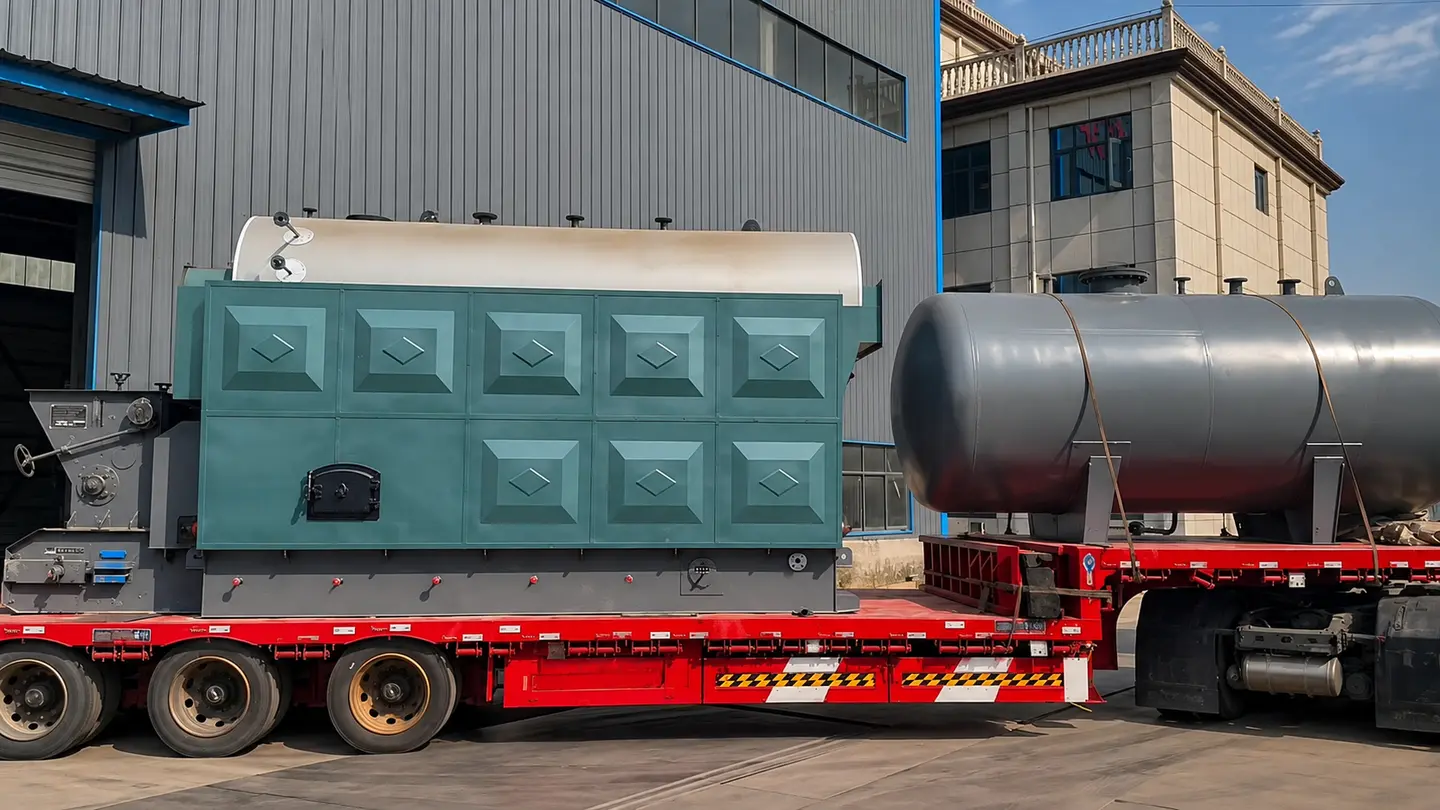
COMPLETE SYSTEM SCOPE
The Boiler, Fuel Handling, Air System and Dust Route Must Work as One Plant.
A reliable DZL system coordinates the boiler body with fuel storage and feeding, forced and induced draft, feedwater, heat recovery, dust removal, controls, ash handling and the customer’s steam network.
Not every item is included by default. The final supply boundary, emission equipment, electrical scope, component brands and site interfaces are stated in the approved proposal.
Define your system boundaryPRODUCT OVERVIEW
Stable Steam Starts with Matching the Grate to the Real Fuel.
The DZL series combines a horizontal single-drum boiler body with a travelling chain grate. Prepared fuel is fed at a controlled rate while primary and secondary air are coordinated with the combustion zone.
Capacity alone cannot define the correct configuration. Fuel lower heating value, moisture, ash, particle size, bulk density and slagging tendency directly affect the grate, feeding system, furnace, air distribution and dust-removal route.
Mechanized Fuel Feeding
The chain-grate route supports controlled fuel movement and more consistent firing than manual batch feeding.
Zoned Primary Air
Independent wind sections distribute combustion air beneath the grate according to the fuel-burning stage.
Secondary-Air Support
Configured secondary air promotes mixing of released volatiles above the fuel bed.
Project-Matched Emission Route
Dust collection and flue-gas treatment are selected from fuel ash and applicable local requirements.
HOW THE DZL BOILER WORKS
Fuel Travels Across the Grate as Heat Moves Through the Boiler Heating Surfaces.
Prepared biomass enters the hopper and is distributed onto the chain grate. As the grate advances, fuel passes through drying, ignition, main combustion and burnout zones.
Heat is absorbed by the furnace-side water-cooled surfaces and boiler body. Flue gas continues across the configured tube heating surfaces before entering the economizer, dust collector, induced-draft fan and chimney route.
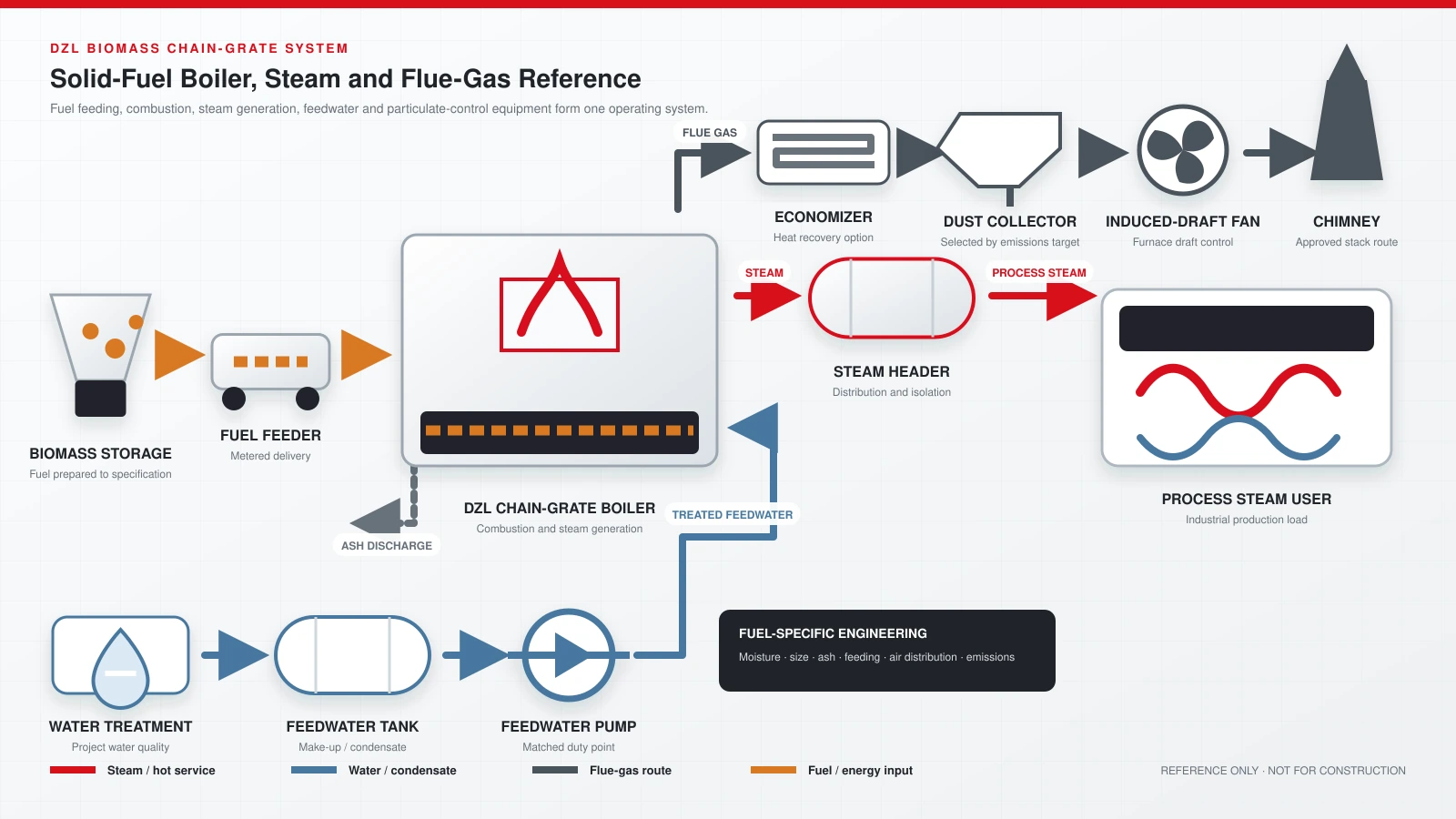
REFERENCE SYSTEM DIAGRAM
How Fuel, Steam, Water and Flue Gas Move Through a DZL System.
This reference route brings together biomass preparation and feeding, chain-grate combustion, steam delivery, feedwater, heat recovery, particulate control, induced draft and ash discharge.
DESIGN FEATURES
Built Around Continuous Solid-Fuel Combustion and Practical Operation.
The following features describe the current JINHONG DZL product route. Final materials, construction details, component brands and performance requirements follow the approved technical proposal and drawings.
01 / FIRING
Travelling Chain Grate
Mechanized grate movement supports controlled fuel travel and continuous combustion.02 / BOILER BODY
Horizontal Single-Drum Layout
The drum, furnace-side heating surfaces and threaded smoke tubes form the core steam-generation body.03 / HEAT TRANSFER
Threaded Smoke Tubes
Threaded tubes increase gas-side disturbance and support effective heat transfer across the boiler body.04 / AIR SYSTEM
Primary and Secondary Air
Air distribution is coordinated below and above the grate for the approved fuel route.05 / ACCESS
Inspection and Cleaning Access
Access points support routine furnace, grate, ash and heating-surface inspection.06 / DELIVERY
Transport-Scope Planning
Larger models may ship in major sections; transport limits and site assembly are reviewed before production.FUEL ENGINEERING
Send the Fuel Data Before We Fix the Furnace and Feeding System.
“Biomass” covers fuels with very different combustion behavior. A pellet, wood chip, rice husk and fibrous agricultural residue cannot automatically use the same hopper, grate, furnace volume or air distribution.
A representative fuel sample, laboratory report or clear operating data helps avoid unstable output, bridging, clinker formation and excessive carryover.
For the checks behind these requirements, see our biomass fuel evaluation guide.
Lower Heating Value
Provide the as-fired net calorific value, not only a generic fuel name.
Moisture and Ash
These values affect ignition, furnace temperature, flue-gas volume and ash handling.
Particle Size and Density
Fuel dimensions and bulk density determine storage, conveying and fuel-bed behavior.
Ash Fusion and Contaminants
Slagging tendency, soil, stones, metal and mixed waste must be identified before design.
INDUSTRIAL APPLICATIONS
For Plants with Suitable Biomass Supply and Steady Process-Steam Demand.
Industry name alone cannot select the boiler. Steam load, working pressure, operating hours, fuel consistency, water quality, emission limits and space must be reviewed together.
Textile & Dyeing
Steam for washing, dyeing, drying and finishing where a prepared biomass fuel supply is available.
Explore solution →Food Processing
Process steam for cooking, cleaning, sterilization and thermal production duties.
Explore solution →Paper & Packaging
Steam for drying, corrugating, process heating and continuous utility loads.
Explore solution →Rice & Grain Mills
Steam for parboiling, drying and processing, with fuel preparation matched to local residues.
Explore solution →Feed Mills
Steam for conditioning, pelleting and process-heating duties across production lines.
Explore solution →Wood Processing
Steam for veneer, plywood, drying and pressing where suitable wood residues are controlled.
Explore solution →SELECTION INPUTS
Send the Actual Steam and Fuel Conditions.
Start with your process, estimated steam demand and available biomass. A laboratory report is not needed for the first enquiry; fuel quality, working pressure, emissions and system scope must be checked before the configuration is confirmed.
Send Project Data- 01Steam RequirementNormal and peak load, pressure, hours per day and load variation
- 02Fuel ReportHeating value, moisture, ash, size, bulk density and annual availability
- 03Water & CondensateRaw-water analysis, feedwater route and condensate-return condition
- 04Site & EmissionsDestination, elevation, available footprint, transport limits and local standards
- 05Supply BoundaryFuel handling, dust collection, installation guidance, electrical standard and documentation
FREQUENTLY ASKED QUESTIONS
DZL Biomass Boiler Selection Questions.
Which biomass fuels can a DZL boiler use?
The standard route is suitable for prepared, reasonably uniform biomass fuel such as qualified pellets and appropriately sized wood-based fuel. Agricultural residues may require different storage, conveying, grate, furnace and air-system design. Send a fuel report or representative sample before the configuration is fixed.
Can the same standard boiler burn rice husk?
Do not assume that a standard pellet configuration can directly burn rice husk. Rice husk has different bulk density, ash behavior and carryover characteristics. JINHONG must review the fuel and determine the feeding, furnace, grate, air and dust-removal route.
Is fuel feeding fully automatic?
The chain grate provides mechanized fuel movement, while the degree of storage, conveying, feeding and ash-handling automation depends on the approved supply scope and fuel form.
How is the correct steam capacity selected?
Use the normal and peak steam demand, working pressure, operating schedule, condensate return and future margin. Oversizing only from a nameplate total can reduce operating efficiency and combustion stability.
Is the dust collector included?
Not automatically in every proposal. Dust collection and any additional flue-gas treatment are selected from fuel ash, emission requirements and the destination standard, then listed clearly in the approved scope.
Are the technical data dimensions final?
No. They are preliminary reference values. Final transport sections, weights, foundation loads and installation dimensions follow the approved manufacturing drawings.
START WITH THE FUEL
Get a DZL Proposal Based on Your Steam Load and Biomass Data.
Start with your process, project country, available fuel and email or phone. Capacity, pressure and a fuel report can be added during technical review before the boiler and system boundary are confirmed.