
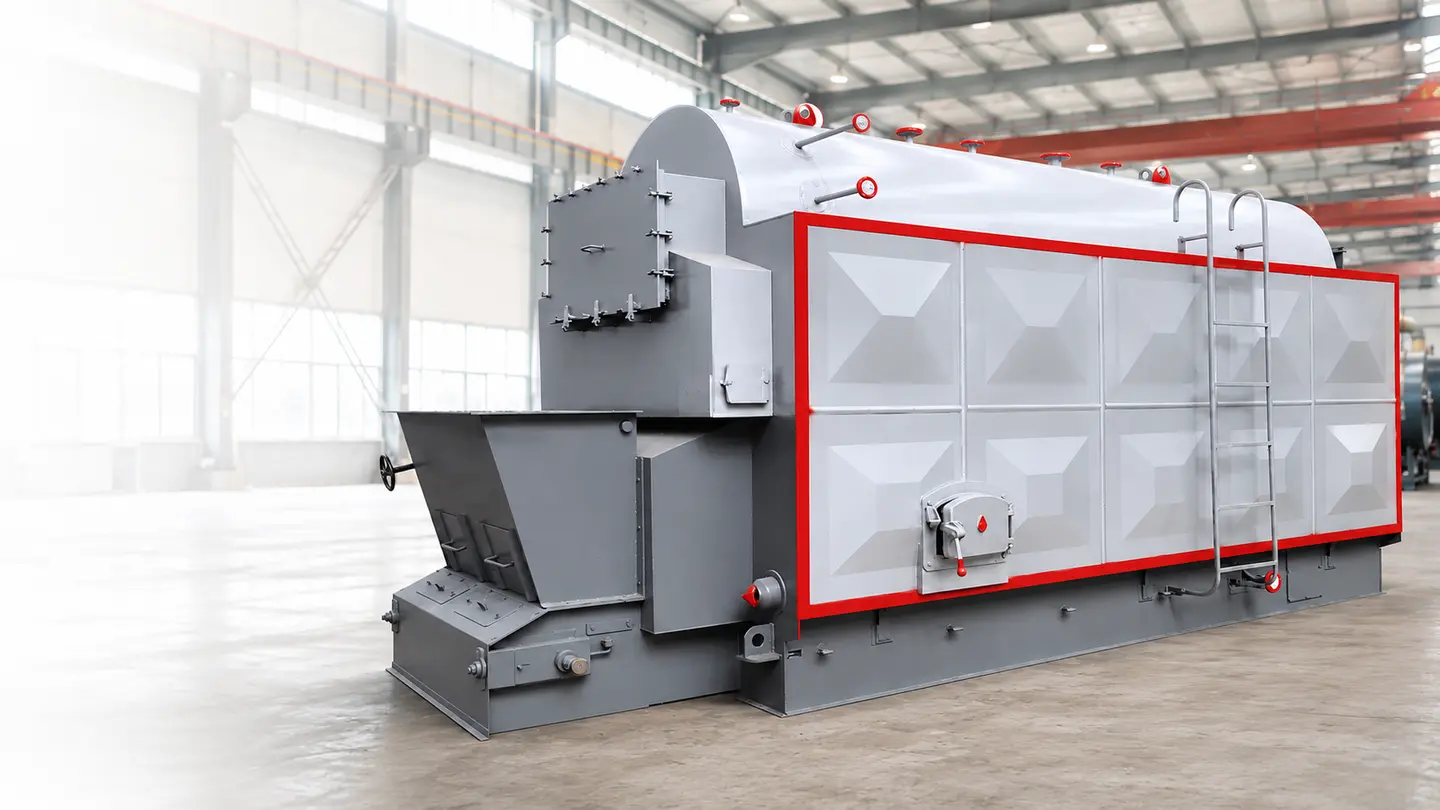
A biomass boiler is a complete fuel-to-heat system
At its simplest, a biomass boiler burns biological material to heat water or another heat-transfer medium. In an industrial plant, however, the boiler body is only one part of the system. Reliable operation also depends on fuel receiving, storage, conveying, metering, combustion air, ash removal, flue-gas cleaning, water treatment, controls and the heat distribution network.
Biomass can include forest residues, sawdust, wood chips, pellets, rice husk, bagasse, palm residues and other agricultural by-products. These materials are not interchangeable. Moisture, particle size, bulk density, ash chemistry and calorific value directly affect the equipment selection.
How does an industrial biomass boiler work?
- Fuel receiving and storage: delivered fuel is kept dry and managed to limit contamination, bridging, self-heating and inconsistent blending.
- Metered feeding: conveyors, screws, ram feeders or other devices deliver a controlled fuel rate to the furnace.
- Combustion: primary and secondary air support drying, ignition, volatile-gas combustion and char burnout.
- Heat transfer: radiant and convective surfaces transfer heat to water, steam or thermal oil.
- Ash and gas handling: bottom ash and fly ash are collected; particulate and gaseous emissions are treated as required.
- Controls: fuel, air, draft, water level, pressure and safety interlocks respond to load while protecting the equipment.
The exact arrangement changes with capacity, pressure, fuel and local emission limits. A small pellet-fired hot-water unit and a large rice-husk steam plant are both biomass boilers, but their engineering boundaries are very different.
Common biomass fuels and their design effects
| Fuel example | Typical engineering concern | System implication |
|---|---|---|
| Wood pellets | Uniform size and relatively high bulk density, but quality and fines still vary. | Accurate metering and protected storage. |
| Wood chips | Moisture, oversize pieces and bark content can change substantially. | Robust handling, screening and adequate furnace drying capacity. |
| Rice husk | Light bulk density and distinctive ash behavior. | Fuel-conveying and ash-design review based on actual analysis. |
| Bagasse | High moisture and seasonal availability. | Large fuel volume, drying/combustion capacity and supply planning. |
| Mixed agricultural residue | Variable size, ash, contaminants and fusion behavior. | Defined acceptance limits, blending and flexible combustion control. |
Which combustion system is suitable?
Fixed grates, reciprocating grates, chain grates, suspension systems and fluidized beds each have a different operating envelope. The right route depends on fuel form, moisture, ash, capacity, load variation and the plant’s maintenance capability.
Uniform fuel may permit simpler feeding and stable automatic control. Wet, fibrous or high-ash material generally needs more furnace volume, stronger handling equipment and closer attention to ash deposition. The combustion system should be selected from the fuel—not the other way around.
What can a biomass boiler supply?
- Steam: process heating, drying, sterilization, cooking, textile operations and other industrial users.
- Hot water: space heating, washing and lower-temperature process loads.
- Thermal oil: indirect heating where the process needs higher fluid temperature at relatively low pressure.
- Combined heat and power: larger plants may produce electricity and useful heat, subject to a full technical and economic study.
The useful output must be defined by capacity, pressure or temperature, operating hours, peak demand and load profile. Boiler selection from fuel alone is incomplete.
Benefits and trade-offs
Potential benefits
Locally available residues can reduce reliance on imported fossil fuel, create value from a waste stream and support a lower fossil-carbon energy strategy. Biomass storage may also provide a degree of on-site fuel resilience.
Important trade-offs
Solid fuel is bulky and variable. The plant usually needs more space, moving equipment, operator attention, ash handling and emission control than a comparable gas-fired system. Sustainability also depends on responsible sourcing, transport distance, land-use impacts and complete combustion.
Biomass combustion releases carbon dioxide and air pollutants. Its environmental performance is not automatically neutral; it depends on the fuel lifecycle, combustion efficiency and emissions controls.
When is biomass a good fit?
Biomass is most attractive when a stable, specification-controlled fuel is available near the site; the heat load is sustained; the plant has storage space; and operators can manage fuel, ash and maintenance. It is less attractive when fuel supply is uncertain, the site is space constrained, the load is highly intermittent or local emission limits cannot be met economically.
Information needed before requesting a quotation
See the Kenya 8 TPH biomass steam boiler project for a supplied configuration with hydraulic feeding and a hydraulic reciprocating grate. Its confirmed fuels and services are specific to that project.
- Required steam, hot-water or thermal-oil output
- Working pressure or supply/return temperatures
- Hourly, daily and seasonal load profile
- Fuel source, annual quantity and delivered form
- Moisture, calorific value, size distribution and ash analysis
- Available space, utilities and ash-disposal route
- Local emission limits and applicable boiler code
With these inputs, the boiler supplier can review the boiler, fuel system, auxiliaries and site interfaces as one project.
Technical references
This guide summarizes general engineering principles. Final equipment selection must be based on representative fuel data, project conditions, local codes and manufacturer calculations.